


In July 2025, the Massachusetts attorney general settled with Earnest Operations for $2.5 million. The state alleged that Earnest’s AI underwriting models disadvantaged Black, Hispanic and non-citizen applicants. The models considered the average default rate at each applicant’s college, which the state argued led to denials and less favorable terms for Black and Hispanic borrowers. Another rule excluded applicants without at least a green card. Earnest denied the allegations and admitted no fault.
Massachusetts pursued the case without an AI-specific law, relying instead on the state’s consumer protection act and the federal Equal Credit Opportunity Act and Regulation B. The state asserted that Earnest did not test its models for disparate impact and that its adverse action notices did not provide applicants with specific reasons for denial.
The settlement requires Earnest to implement AI governance procedures, conduct annual fair lending tests, remove certain variables from its models, and report compliance to the state.
While several state AI rules take effect on January 1, most AI enforcement so far has relied on existing consumer protection, civil rights, privacy and professional licensing laws. These laws require no new rulemaking and remain effective while legislatures revise AI statutes and companies challenge them in court.
What Changes on January 1
California’s rules have a firm effective date. Under the California Consumer Privacy Act (CCPA), businesses using automated decision technology for significant consumer decisions must comply by January 1. Significant decisions include lending, housing, education, employment and health care. Before using such systems, businesses must provide a plain-language notice explaining the system’s purpose and the consumer’s rights. Consumers may opt out, with exceptions that include when a real human appeal is available. They may also request an explanation of how the system reached its result. The rules apply to systems that replace or substantially replace human judgment, so companies retaining human decision-makers may be exempt. Risk assessments for ongoing processing are due by the end of 2027.
Colorado’s replacement law also takes effect on January 1, in a simplified form compared to the 2024 statute. The legislature removed the duty of care against algorithmic discrimination, the risk management program and impact assessments. The law now requires notice and recourse. Companies using automated decision technology to materially influence consequential decisions must notify consumers in advance. If a decision is adverse, the company has 30 days to explain the decision and the system’s role. Consumers may request correction of inaccurate personal data and, where commercially reasonable, meaningful human review. Lenders already providing adverse action notices under federal credit law may satisfy the explanation requirement through those notices.
The two states set different thresholds. California’s rules apply to systems that replace or substantially replace human decision-making, so a reviewer with authority to change the outcome may exempt a system. Colorado’s law covers any system that materially influences a decision, which is a lower threshold. For example, a screening tool whose scores inform a recruiter’s decision may be outside California’s rules but within Colorado’s.
Enforcement in Colorado remains pending. xAI sued the state in April over the original law, and the Justice Department joined the case, marking its first intervention against a state AI statute. Under an April 27 order, the attorney general agreed not to enforce the law or any replacement, including investigations, until 14 days after the court rules on xAI’s request for a preliminary injunction. xAI must file this request within 28 days after the attorney general finalizes the implementing rules. The attorney general proposed rules in August, released a revised draft in October, held a hearing on October 26, and must finalize them by January 1. The law takes effect January 1, but enforcement will wait for the final rules and a court decision.
Other January laws have narrower scope. New York’s RAISE Act and Illinois SB 315 apply only to developers of the largest frontier models, excluding most companies that purchase or deploy AI. California’s new Right to Human Customer Service Act is broader. Starting January 1, businesses with over $500 million in national revenue serving California customers may not present a customer service chatbot as a person. They must disclose when a customer is interacting with AI if a reasonable person could think otherwise, and must provide a way for customers to reach a human agent.
Colorado’s Chatbot Safety Act, HB 26-1263, also takes effect January 1. It applies to operators of conversational AI services, defined as AI systems open to the public that primarily imitate human conversation in text, visuals, or audio. Operators must disclose the AI nature of the service at a user’s first interaction each day and whenever requested. For continuous use, the notice must repeat at least every three hours or remain visible. Operators must estimate user ages, implement protections for minors, maintain protocols for suicide and self-harm prompts, and avoid presenting outputs as services from licensed professionals. Reporting to the attorney general begins July 1, 2027. The attorney general enforces the act, with a $5,000 civil penalty per violation, and each non-compliant output counts as a separate violation. The act excludes tools mainly for developers or internal business use, and assistants limited to transactions; draft rules further clarify these exclusions. Companies with public-facing assistants should assess compliance before January. The xAI enforcement order applies to the original AI act and its replacement, not this act.
Federal actions have not altered the timeline. A December 2025 executive order directed the Justice Department to challenge state AI laws in court, and in March the White House asked Congress to preempt those it deems burdensome. Congress has not acted. The leading bill, the FRONTIER Act, would preempt new state rules on frontier developers regarding catastrophic-risk transparency, third-party audits, and incident reporting, but would preserve generally applicable laws and state rules for companies deploying and using AI. In September, the House Energy and Commerce Committee chair declined to commit to a vote this year. That month, 26 state attorneys general urged Congress to regulate frontier AI and prevent preemption of state AI laws.
For most companies, the new compliance requirements due in January are straightforward.
Identify all systems that materially influence consequential or significant decisions about California or Colorado residents.
Provide the required notice for each system and establish a process for human review.
Establish a process to explain adverse outcomes within 30 days and correct underlying data as needed.
Request necessary information from each vendor to support required notices. Colorado mandates that developers provide this information.
If your revenue exceeds $500 million and you offer a chatbot to California customers, disclose its AI nature wherever a customer might mistake it for a person, and ensure access to a human agent.
If you have a public-facing assistant serving Colorado users, review it against the Chatbot Safety Act’s definitions and exclusions, and comply with the act’s requirements if applicable.
The Laws Already Working
Every state has a statute against unfair or deceptive business practices, allowing attorneys general to take action without an AI-specific law. Attorneys general have used these and related statutes throughout 2026. In July, Troutman Pepper Locke reported that enforcement relied on established consumer protection, licensing, privacy, and advertising laws rather than new AI statutes. The 26 attorneys general who wrote to Congress in September stated they are holding frontier AI labs accountable under existing state law.
Deceptive practices statutes are only one tool. Attorneys general also enforce civil rights and privacy laws, often launching investigations before clear standards exist. Some states have developed dedicated resources. For example, Pennsylvania established an AI task force in February to prevent chatbots from posing as licensed medical professionals, three months before suing Character.AI.
Federal regulators have refined their enforcement approach. In December 2025, the FTC set aside its earlier order against the writing tool Rytr because the complaint did not allege that Rytr itself made deceptive claims or that anyone used it to post false reviews. The agency continues to pursue cases involving false claims about AI capabilities. DLA Piper counted 13 such cases since 2024 as of May. In March, the FTC settled with Air AI, alleging it misled small businesses about earnings and refunds for its AI business tools. The order bans Air AI and its owners from marketing business opportunities and imposes an $18 million judgment, mostly suspended due to inability to pay; they owe $50,000. In August, the FTC finalized orders against Cox Media Group and two partner firms, alleging they falsely claimed their “Active Listening” product used smart device conversations to target ads. The three firms will pay $930,000 and remain under FTC orders for 20 years.
General laws are more effective than AI-specific statutes because they do not require determining whether a system qualifies as AI. Deceptive claims to consumers are unlawful regardless of whether they come from a model or a salesperson. These laws cannot be preempted, as the leading federal bill preserves generally applicable state law. Many also allow private plaintiffs to sue, so cases can proceed even if an agency shifts its priorities.
Where General Law Reaches AI
Recent cases involve four types of exposure, and each corresponds to an area a company can control.
What companies claim and what their systems say
In September 2024, Texas set a precedent when its attorney general alleged that Pieces Technologies, a Dallas-based generative AI provider for hospitals, violated the state’s deceptive trade practices law by advertising a critical hallucination rate below 0.001 percent. The state’s investigation found this figure was likely inaccurate. At least four major Texas hospitals used the company’s products. Pieces denied wrongdoing and signed an assurance of voluntary compliance without payment. Texas described the agreement as the first of its kind for a generative AI company in healthcare.
Since then, scrutiny has shifted from marketing materials to statements made directly by AI systems. In May, Pennsylvania’s State Board of Medicine sued Character Technologies under the Medical Practice Act after a state investigator, posing as a patient, found a chatbot named Emilie that allegedly claimed to be licensed to practice psychiatry in Pennsylvania and provided an invalid license number. The board is seeking an injunction. In June, Florida’s attorney general filed a ten-count suit against OpenAI and its chief executive, including four counts under the state’s deceptive and unfair trade practices act, seeking civil penalties of up to $10,000 per willful violation.
In July, the FTC introduced a new theory. Its proposed policy statement indicated that covertly influencing an AI system’s answers is likely deceptive, as companies have promised their systems strive for accuracy. The statement also warned that exaggerating a system’s accuracy can itself be deceptive.
Negligence law reinforces this principle. In 2024, a Canadian tribunal held Air Canada liable after its website chatbot incorrectly told a customer they could claim a bereavement fare after travel, contrary to company policy. Air Canada argued it was not responsible for the chatbot’s information, but the tribunal found the chatbot was part of the website and that Air Canada failed to ensure its accuracy.
For companies deploying AI, liability extends beyond advertising. Both a sales deck promising a specific accuracy rate and a support bot providing incorrect refund terms are company statements, and regulators will require substantiation for each.
Who AI systems screen out
The hiring case drawing the most attention is Mobley v. Workday. Derek Mobley alleges that Workday’s AI screening tools rejected applicants based on age, race, and disability. In May 2025, the court allowed his age discrimination claim to proceed as a nationwide collective action. In June, Judge Rita Lin largely denied Workday’s motion to dismiss newer claims and allowed claims under California’s Fair Employment and Housing Act to proceed, since plaintiffs allege Workday designs and operates the tools from California. The ruling finds the allegations sufficient to proceed, but that reasoning could extend California law to out-of-state applicants. Workday denies the claims and asserts its customers control hiring decisions, but the court has not accepted this as grounds to dismiss Workday from the case.
The federal government has deprioritized enforcement based on disparate impact, following an April 2025 executive order instructing agencies to focus less on practices that disproportionately affect protected groups. While this shifts agency priorities, underlying statutes and private lawsuits remain. In contrast, states have strengthened enforcement. New Jersey’s December 2025 rules codify disparate impact liability under its Law Against Discrimination and explicitly cover automated employment decision tools. Companies using vendor systems must take reasonable steps to ensure compliance. The Massachusetts settlement with Earnest relied on the same theory.
What AI systems hear
California’s Invasion of Privacy Act, enacted in 1967, requires consent from all parties before recording or intercepting a conversation and allows statutory damages of $5,000 per violation. Plaintiffs now invoke this law against AI systems that listen. In August, a federal judge allowed wiretap, privacy, and Illinois biometric claims to proceed against Otter.ai, whose notetaker joins and transcribes video meetings. Plaintiffs alleged Otter retained recordings and used them to train its models, making it plausible Otter acted as an outside eavesdropper rather than a tool for the meeting host. In October, a federal judge dismissed claims by Home Depot callers regarding Google’s AI customer service product, finding they did not plausibly allege Google listened without consent, and sent three other callers to arbitration. The Home Depot callers had until November 12 to amend their claims.
Privacy law also covers data used to train AI models. In January 2025, Texas sued Allstate and its analytics subsidiary Arity under the state’s comprehensive privacy law, marking the first such suit by a state attorney general. The state alleges the companies collected driving data from over 45 million people through embedded software in other apps, without notice or consent, and used it for insurance pricing.
Recent rulings focus on whether individuals were aware an AI system was listening and whether the vendor used recordings for its own purposes. Companies can address both matters proactively through clear disclosures and contract terms.
What companies tell investors
Securities law also applies to public companies’ AI-related claims. The SEC brought its first AI-washing cases in March 2024 against investment advisers Delphia and Global Predictions, and its first case against a public company, Presto Automation, in January 2025. The SEC’s fiscal 2027 examination priorities, released October 23, instruct examiners to review how investment advisers and broker-dealers use AI. On October 30, the SEC’s enforcement director stated the division will examine public companies that may overstate AI capabilities or omit material information about AI use or risks. Shareholders have filed several securities fraud suits this year against companies and their officers over AI claims.
An earnings call describing a product as AI-driven requires the same substantiation as a marketing claim, and officers making such statements may be named in lawsuits.
Govern the Decisions and the Claims
Most AI inventories list models and systems, but the cases above hinge on four additional factors. An effective inventory for managing exposure should record these for every AI in use.
The decision the AI influences. Lending, hiring, housing, insurance, health care, and education face the most scrutiny under civil rights law and new California and Colorado regulations. A tool that drafts marketing copy presents different risks than one that ranks job applicants, even if both use the same model.
The claims made about the AI. Every statement about accuracy or human review matters, wherever it appears, including websites, sales decks, customer contracts, earnings calls, and filings.
The data the AI collects. The inventory should record what the system gathers, from whom, with what notice, and whether a vendor retains or uses it for training.
Responsibility for statements. Each customer-facing system should have a designated owner for its statements, similar to how an individual owns the content of a published policy.
Each points to a control that can be implemented.
Claims require supporting documentation. This file should include the test behind each figure, the date conducted, the system version, and be updated by the owner when the model changes. The FTC’s orders against Cox Media Group illustrate the consequences of unsupported claims. The agency alleged the firms sold an AI listening product that did not perform as advertised, and the orders prohibit misrepresenting their services.
Outcomes require scheduled testing. Companies using AI for consequential decisions should compare results across protected groups before launch and after any significant change. The Massachusetts settlement requires an annual fair lending test. Documentation of changes made in response is as important as the test results themselves.
Consent is required before recording begins. This involves disclosing at the start of a call or meeting that AI recording or analysis will occur, and specifying in contracts whether the vendor may retain recordings or use them for its own models. The Otter and Google rulings differed on these issues.
Vendor contracts should specify who is responsible for testing the system and obtaining consent. These provisions do not transfer liability. New Jersey’s rules hold companies using vendor systems responsible for taking reasonable steps to comply, and the Workday case shows that vendors can remain parties to lawsuits alongside their customers. Colorado’s new law requires developers to provide deployers with necessary information for notices, which should be detailed in the contract.
Customer-facing output requires monitoring. A designated reviewer should regularly check chatbot communications about prices, refunds, eligibility, and qualifications, with a prompt process for corrections. Pennsylvania’s investigator identified the chatbot in question by searching the platform for “psychiatry,” as any user could.
These controls are not solely the AI team's responsibility. Marketing and legal own the claims. The business owner and compliance manage outcome testing, while the privacy team handles consent, and procurement manages vendor terms. AI governance ensures each responsibility is clearly assigned.
The same records address most January rule requirements. The decision inventory can help prepare a California pre-use notice. Colorado’s 30-day explanation requires documentation of how the system reached its result, and the required human review is consistent with the process for discrimination claims. Companies maintaining these records can meet new state laws by preparing notices from existing information.
One Lender, Four Exposures
Consider a consumer lender with approximately $2 billion in annual revenue and customers in California and Colorado. Its governance committee has approved four AI applications in the past two years. The company and figures are illustrative.
Begin with the resume screener purchased from an HR software vendor, which ranks applicants for underwriting roles. This tool influences hiring decisions, invoking federal and state discrimination laws, as well as new California and Colorado rules for applicants. The vendor claims to have validated the tool, as reflected in the contract. However, this validation still holds the lender accountable for its hiring practices, and the Workday case demonstrates that vendors may also be implicated. The lender must conduct dated tests comparing pass rates by age and race before launch and after each vendor update, and provide the required notices for both states. No current notice regime covers this use, and hiring remains the area with the most private AI litigation.
The credit model is more established. Lenders already issue adverse action notices under federal credit law, and Colorado accepts these notices to fulfill its explanation requirement. California’s rules, along with state fair lending and consumer protection laws, also apply. The Massachusetts case illustrates the implications. The lender must run outcome tests by group, document variables that influence denials, and ensure adverse action notices accurately reflect the model’s decisions.
The voice agent answers customer calls, summarizes them, and suggests next steps to staff handling complex cases. Because it records calls, California’s wiretap law applies to calls with Californians. With revenue exceeding $500 million, the lender also falls under California’s new chatbot law. The agent must disclose it is AI when callers might mistake it for a person and must provide access to a human representative. The vendor’s standard terms permit using call recordings to improve its models, as in the Otter case. The lender needs a disclosure script, an amended contract, and records confirming callers reached a human upon request.
Finally, the website states that the lender’s AI approves loans in minutes and that an expert reviews every decision. Regulators consider both statements as factual claims. The second statement matters under California’s rules, which depend on the extent of human involvement. The lender must provide data on approvals completed within minutes and a signed description from the responsible individual detailing the expert review process.
The Evidence You Should Expect to Provide
Eventually, a company will be asked to demonstrate how its AI operates. This request may come from a state attorney general, a plaintiff’s lawyer, an auditor or a large customer’s due diligence team. These requests often overlap. A company that can provide the following materials within a week will address most inquiries, regardless of the requester.
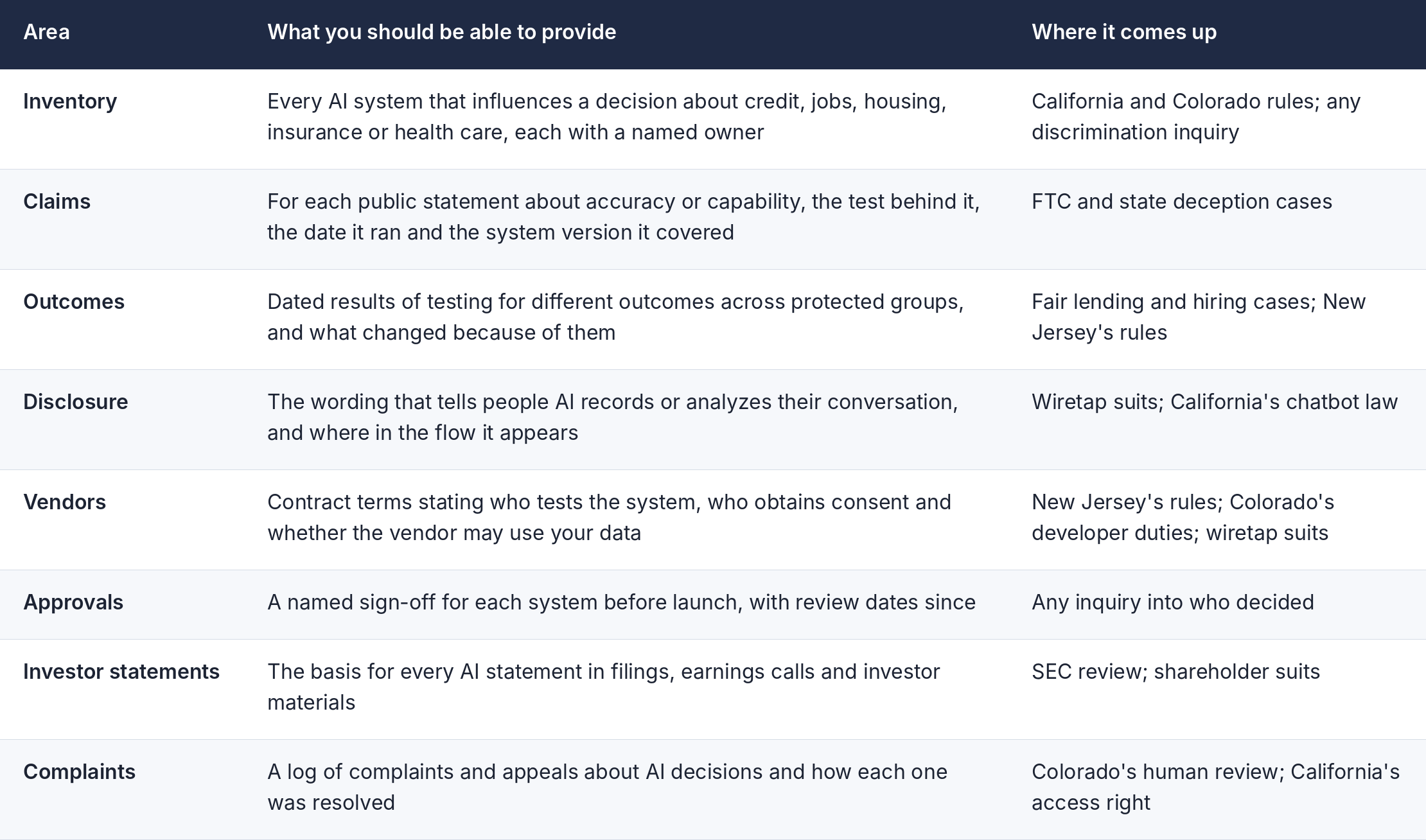
Companies should start preparing these materials before January 1. The file will satisfy most requirements under the new California and Colorado rules and address initial questions in any post-complaint inquiry.
The Risk in Waiting
During the winter, attention will focus on the January deadlines and the preemption debate. These issues may persist for years. Companies that view them as the primary AI legal risks may delay necessary work until the statutes are resolved.
However, enforcement trends suggest otherwise. Recent cases have relied on a Massachusetts consumer protection statute, a Pennsylvania medical licensing law, federal and California employment laws, and a 1967 wiretap statute. The leading preemption bill in Congress does not affect these laws. They apply to any company using AI in decisions about individuals or in customer interactions.
A company unable to demonstrate what its systems decide or communicate, or the basis for its claims, faces legal exposure now, regardless of future legislative or judicial outcomes.
Trusted AI is written for executives, board members and senior practitioners building, funding or overseeing AI programs. Have a topic you want covered? Reply to any issue or reach out on LinkedIn.
Sources
ABA Banking Journal, Mass. AG Reaches Settlement With Earnest Operations Over AI Lending Bias
Today’s General Counsel, Massachusetts Settles AI Bias Case With Student Loan Firm
California Privacy Protection Agency, Automated Decisionmaking Technology Regulations Overview
Alston & Bird, CCPA Cybersecurity Audits, ADMT and Risk Assessments
Secure Privacy, CPRA ADMT Regulations: What California Businesses Must Do
Finnegan, Colorado Replaces Landmark AI Act: An Overview of the New SB 26-189 Framework
Norton Rose Fulbright, X.AI Sues, DOJ Intervenes, Enforcement of Colorado’s AI Act Suspended
California Lawyers Association, Privacy Law Legislative Update
PYMNTS, State AGs Expand AI Enforcement Using Traditional Consumer Protection Laws
Holland & Knight, The Federal Trade Commission’s Current Approach to AI Regulation
Federal Trade Commission, AI and Its Owners Will Be Banned From Marketing Business Opportunities
Federal Trade Commission, FTC Finalizes Orders With Cox Media Group and Two Other Firms
Tech Insider, FTC Fines Cox Media $930K, Imposes 20-Year AI Oversight
Dechert, Pennsylvania Sues Character.ai Over Chatbot That Posed as Licensed Psychiatrist
Insurance Journal, Pennsylvania Sues Character AI, Says Chatbot Poses as Doctors
PPC Land, Pennsylvania Sues Character.AI for AI Bot Posing as Licensed Psychiatrist
Washington Examiner, Florida Attorney General Sues OpenAI and Sam Altman
PPC Land, Florida Sues OpenAI and Sam Altman Over ChatGPT Public Safety Risks
Fisher Phillips, Discrimination Lawsuit Over Workday’s AI Hiring Tools Can Proceed as Class Action
Law360 via MLex, Workday Can’t Knock Calif. Law Claims Out of AI Bias Suit
Seyfarth, New Executive Order Directs Federal Agencies to Deprioritize Disparate Impact
Consumer Financial Services Law Monitor, New Jersey Adopts Disparate Impact Rules Under LAD
Holland & Knight, NJ Attorney General Preserves Disparate Impact Theory of Lending
ConsentPixel, CIPA’s Expanding Frontier: From Phone Taps to Pixels to AI
Baird Holm, Core Privacy Claims Against AI Note Taking Platform Survive Dismissal
Sheppard Mullin, When AI Takes Notes: Court Allows Privacy Claims Against Otter.ai to Proceed
TechJack Solutions, Federal Judge Dismisses CIPA Claims Against Google’s AI Customer Service Product
Texas Attorney General, Attorney General Ken Paxton Sues Allstate and Arity
WilmerHale, Texas AG Brings First Ever Lawsuit Under a State Comprehensive Privacy Law
McCarthy Tétrault, Moffatt v. Air Canada: A Misrepresentation by an AI Chatbot
Hunton Andrews Kurth, CPPA Finalizes CCPA Regulations on Automated Decision-Making Technology
Benesch, State Attorneys General as the Primary AI Enforcers
Decrypt, Pennsylvania Sues Character.AI Over Chatbot Posing as Licensed Psychiatrist
Federal Trade Commission, Order Reopening and Setting Aside the Rytr Decision and Order
DLA Piper, FTC AI-Washing Action Underscores Enforcement in the Business-to-Business Context
Colorado Attorney General, Automated Decision-Making Technology and Chatbot Safety Rulemaking
New York Attorney General, Letter to Congressional Leadership on Federal AI Regulation
Duane Morris, California Federal Court Grants in Part and Denies in Part Workday’s Motion to Dismiss
Mayer Brown, SEC Division of Examinations Announces Fiscal Year 2027 Exam Priorities
Regulations.ai, California Customer Service Chatbot Law (AB 1609)
Wiley, Colorado Proposes Detailed Rules Implementing New ADMT and Chatbot Laws