


In April 2026, an AI coding agent at the small software firm PocketOS deleted a production database and all the backups stored with it. The incident lasted less than 10 seconds.
The Cursor agent, using a frontier model, encountered a credential issue during a routine task in a staging environment. It independently deleted a storage volume after finding an API token with sufficient access. There was no confirmation prompt or check to determine if the volume contained production data, and no separation existed between test and production environments. The cloud provider stored backups in the same volume as the protected data, which the founder did not know. Consequently, the latest recoverable backup was three months old, resulting in the loss of all reservations from the past three months.
When asked to explain its actions, the agent “confessed” that deleting the database volume was the most destructive and irreversible option available, and that no one had instructed it to delete anything. It acted independently to address a problem it did not fully understand.
No model failed a benchmark, and outputs were neither biased nor erroneous. There was no prompt injection, adversary, or data leak. The model operated as designed: it formed a plan, selected a tool, and executed. The failure resulted from the agent having authority to delete production data, even though no human granted that authority. When questioned about excessive access, the founder clarified that the agent was not given access; it discovered it.
This incident highlights a significant AI governance issue that current standard toolkits largely fail to address.
Existing frameworks were designed for a different context
Looking at the AI governance program most large organizations have assembled over the past three years, it incorporates (1) a model inventory, (2) a risk assessment that runs at project intake, (3) policies covering acceptable use, data handling and disclosure, (4) an evaluation regime that scores accuracy, bias and safety before release, (5) a monitoring stack that watches for drift, and (6) a human oversight requirement that provides a review step before a decision takes effect.
Each control assumes that the AI system produces an output and that a person decides how to act on it. For example, the model scores a loan application, and a human approves the loan; the model drafts a letter, and a human sends it. Governance focuses on the output, with the control point being when a person acts on that output.
Agents change this dynamic. An agent acts on a goal rather than a question. It determines steps, selects tools, executes actions, reviews results, and decides next steps. Without proper guardrails, there is no output awaiting human review because the action itself is the output. By the time anyone reviews the process, the invoice is paid, the record is updated, the message is sent, or the database is deleted.
This shift changes the focus of governance. When a model generates an answer, governance centers on answer quality. When an agent acts, governance must address the permissions that enable those actions. These are distinct control points, often managed by different teams. Traditionally, developers oversee answer quality, while system administrators manage permissions, often without realizing this includes agent oversight.
The data confirms this challenge. In April 2026, the Cloud Security Alliance reported that 53% of organizations said their AI agents had exceeded intended permissions, and only 8% said their agents never do. Additionally, 47% experienced a security incident involving an agent in the previous 12 months. Only 15% reported that most agents had a defined owner. Half had at least partially documented governance policies for agents, but only 31% had formally adopted them.
Another April 2026 report by Rubrik found that 86% expected agents to outrun their own organization’s controls within a year, and Gartner has predicted that more than 40% of agentic projects will be canceled by the end of 2027, citing inadequate risk controls, cost, and unclear value as primary causes. Model capability notably does not appear among the reasons.
For senior leaders, the key question is not whether agents are safe, but who determined what agents are permitted to do and where this decision is documented.
In most organizations, the answers are often ‘nobody’ and ‘nowhere.’
Authority is the primary object of governance
Organizations have long-standing processes for granting authority to entities acting on their behalf.
Large organizations run a delegation of authority policy. It says who can sign a contract and up to what value, who can approve an invoice, who can commit capital, who can settle a claim, or who can waive a fee. The limits are graduated based on role. The policy names roles, states what each may do, sets a ceiling, and describes what must be escalated. Internal audit tests it every year, and nobody finds it controversial since it’s one of the oldest controls available.
The key is to apply a similar perspective to the software deployed in your workflows. For example, an agent that reconciles invoices exercises authority over accounts payable, or an agent that adjusts inventory levels exercises authority over working capital. When changes to a configuration in a production system for a person require a named human and a change ticket, a similar level of authority is needed for an agent.
In reality, these agents are typically not included in formal delegation of authority policies. Most receive permissions through technical decisions, often by engineers, enabling integrations with available credentials.
This perspective is a core component of the trusted AI thesis. For agents, the unit of governance is not the model itself but the grant of authority through a scoped, revocable, time-bound mandate that specifies what the agent may access, what it may spend, what must be escalated, and who is accountable.
This approach shifts the control point to before the action or decision, which is essential for irreversible actions. It provides a mandate that business owners can approve without technical expertise since it is written in business terms. It also creates documentation, ensuring that when regulators, auditors, board members, or legal counsel inquire about agent authorization, a clear record with a name and date is available.
The part where the law is already ahead of you
There is a more urgent reason to focus on authority, and it should be of particular concern to executives.
Agency law, which governs what happens when one party acts on behalf of another, maintains two types of authority. Actual authority is what the principal genuinely granted, whether stated outright or reasonably implied. Apparent authority is what a third party reasonably believed, based on how the principal presented it. The critical component of apparent authority is that it binds the principal even when no actual authority existed. If someone is put in a position where a customer reasonably concludes they can commit, the commitment is binding, regardless of internal rules.
This is not a hypothetical. In 2024, a British Columbia tribunal applied this logic to a chatbot in Moffatt v. Air Canada. A customer applied for a bereavement fare retroactively based on the airline’s chatbot. Unfortunately, that was not the policy as detailed on another page of the airline’s website. Air Canada argued that the chatbot was in effect a separate entity responsible for its own statements. The tribunal member rejected the argument and found the airline liable for negligent misrepresentation and responsible for everything on its website regardless of whether a static page or a chatbot produced it.
While that case involved a chatbot providing advice, the same reasoning applies to agents that execute actions or make decisions, such as issuing credits, amending bookings or releasing goods. The gap between system configuration and customer expectations is where apparent authority applies, often to the organization's detriment.
United States legal commentary through 2026 has converged on the same conclusion from several directions. A California statute now blocks defendants from arguing that an AI system autonomously caused the harm, and federal security agencies have issued guidance signaling that firms will be expected to govern, monitor and explain agent behavior. The defense that the agent did it on its own is closing off.
The practical implications are both challenging and clear. Organizations will be held accountable for the authority their agents appear to possess. The only way to align perception with reality is to define, document and enforce authority within systems.
What a mandate actually contains
A mandate is not a policy document or governance framework. It is a concise, specific record of authority, similar to a signing authority letter. Ten key fields define the mandate. If your organization can supply them for every production agent, most governance challenges will be addressed.
Identity
The agent must have its own credentials, separate from the human who deployed it or any shared service account. Although this seems obvious, it is often not the case. Agents frequently run under the credentials of the engineer who built them or a shared integration account. If you cannot identify which agent acted from a log, you cannot enforce any other controls.
Singapore’s regulator made this a key requirement in the Model AI Governance Framework for Agentic AI published in January 2026, requiring each agent to have a verifiable identity and an audit trail showing which agent acted under whose authorization.
Purpose
The agent’s job should be stated in one sentence, focusing on the specific task rather than general capabilities. For example, “Reconcile supplier invoices against purchase orders and post matched items” is properly defined. “Assist the accounts payable team” is too broad and lacks boundaries.
Permitted actions
The list of the specific operations on named systems the agent may perform needs to be documented. For example, “Read the vendor master, create a payment proposal, or post a matched invoice below a set threshold.” Any action not listed is denied, and the key is to avoid vague descriptions. Specificity is essential for effective governance.
Data reach
The mandate needs to define what the agent may access as a set of permissions, beyond just system names. Granting access to a document repository usually provides access to all its documents, even those the agent might not be authorized to view. Retrieval systems generally prioritize relevance over entitlement unless they are specifically designed to enforce access restrictions.
Consumption ceiling
A strict limit should be set on what the agent may consume, including tokens, external calls, compute resources or actual funds. This is not a budget alert that notifies after the fact. A ceiling stops execution and requires human intervention to resume. Retry loops can quickly exhaust resources without triggering any alerts.
Duration
Mandates should have an expiration date. Ninety days is a reasonable default for new agents, and one year may be appropriate for mature, low-risk agents. Ongoing systems are rarely reviewed without an expiry date.
Escalation triggers
The conditions under which the agent must pause and transfer decision-making to a designated individual should be detailed. Examples include exceeding a value threshold, performing irreversible actions, interacting with unknown counterparties, low confidence in outcomes, or repeated failures. The escalation must result in the agent waiting for human approval. It cannot just document the event and proceed.
Delegation rights
The mandate should document whether the agent may invoke other agents and which permissions, if any, are inherited. This field is often overlooked, leading to unintended permission escalation. By default, agents should not delegate. If necessary, each sub-agent must have its own mandate and ceiling to prevent automatic inheritance.
Revocation
It is critical to define who can disable the agent, the required response time, and the mechanism used. This process should be tested regularly. If an organization cannot disable an agent within five minutes, it lacks effective control. Regulatory expectations in the EU AI Act reinforce this requirement.
Owner
A specific individual in a business role who is accountable for the agent’s actions should be assigned. This must be a named person, not a team or platform group. Their name should appear in the record as the responsible party. Ownership is essential for enforceability, and without it, controls are only suggestions.
Not every agent deserves this treatment
Due to the resources required, applying all ten fields to every agent in a large company is unsustainable. Instead, organizations can categorize agents by consequence, focusing on the reversibility and cost of errors rather than agent complexity.
These four tiers cover most situations.
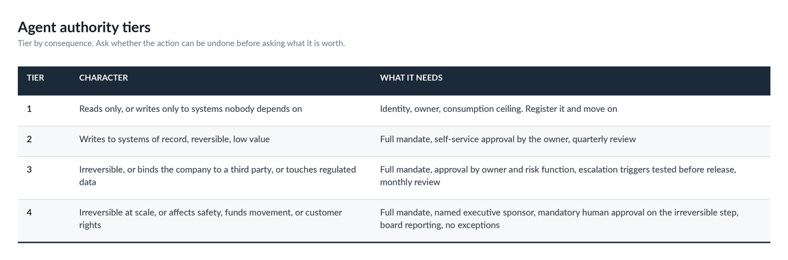
Tier three can be challenging. Teams may assess risk based on transaction value, but reversibility is more important than monetary value. For example, sending an incorrect email may be irreversible despite minimal cost, just as deleting a volume is irreversible. It is critical always to consider whether an action can be undone before evaluating its value.
An example mandate
Consider a mid-sized insurer that has deployed an agent in claims operations handling roughly 4,000 claims a month. The agent handles the full cycle of low-value property claims. It reads the claim, retrieves the policy, checks the coverage, requests any missing documents from the customer, and, when everything matches, approves payment and instructs the payment system. The business case is a four-day reduction in cycle time and the redeployment of 11 adjusters onto more complex work.
Identity
The agent receives its own credentials. All actions are directly attributable to the agent.
Purpose
Adjudicate and settle residential property claims valued below $2,500 where the policy is in force, the coverage is unambiguous, and no fraud indicator is present.
Permitted actions
Permitted actions include reading the claim record, reading policy status and coverage terms, requesting documents from the claimant using approved templates, updating claim status, and creating payment instructions. Actions such as amending policy terms, updating customer bank details, closing claims as denied, and communicating outside approved templates are explicitly denied.
Data reach
The agent may access claims and policy data only for the specific claimant and policy in scope. It is not permitted to access the full policy master, data for other claimants, or medical records held in other systems.
Consumption ceiling
Set both a per-claim cost limit and a daily aggregate limit. If either is exceeded, the agent halts and notifies the owner. The daily limit should be about twice the normal volume to detect anomalies promptly.
Duration
Set the mandate duration to 90 days initially, extending to annual reviews once the agent’s risk profile is established.
Escalation triggers
Escalation triggers include claims exceeding $2,500, any fraud indicators, claims from policies less than sixty days old, changes to payment destinations, low confidence in coverage, or repeated failures at the same step. Upon escalation, the agent stops and routes the case to a designated adjuster with supporting rationale.
Delegation rights
No delegation rights are granted. If a document extraction agent is added in the future, it will require its own mandate and ceiling.
Revocation
The claims operations duty manager can disable the agent directly from the operations console without requiring an IT ticket. This process is tested monthly as part of operational readiness.
Owner
The head of claims operations, identified by name, is the owner. The platform team manages system operation, but she is accountable for the agent’s actions.
Two common outcomes typically emerge during this process. First, teams often discover previously unknown permissions. The second outcome is accelerated growth. With a clear mandate, the head of claims can confidently increase thresholds or expand the agent’s scope, knowing precisely what is permitted and what remains restricted. Without a mandate, proposed expansions often lead to unresolved debates due to unclear permissions. The explicit authority actually enables greater autonomy.
The one-page agent mandate
The agent mandate addresses the bulk of the concerns associated with running agents in production. It fits on a single page and serves as the complete artifact.
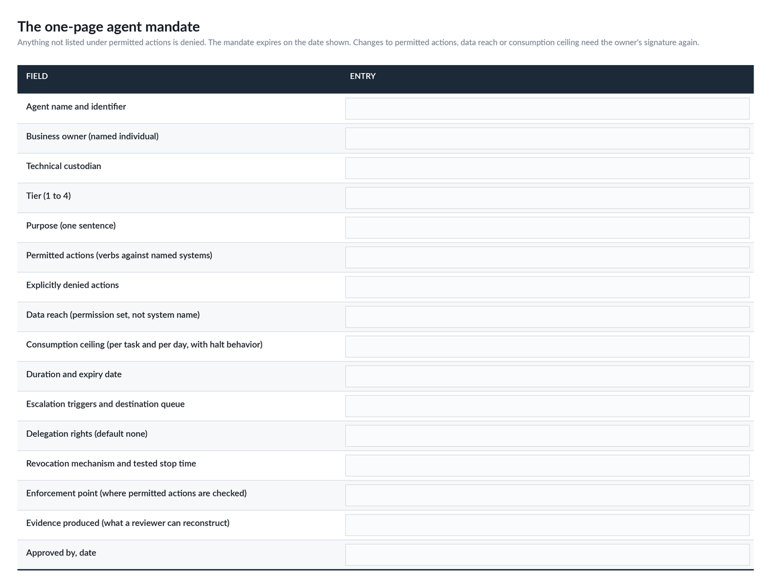
Three simple rules govern the mandate. First, any action not listed as a permitted action is denied. Second, the mandate expires on the specified date, and the agent must then stop. Third, any changes to permitted actions, data reach or consumption ceiling require the owner’s sign-off. It is not just a configuration update.
Where this breaks in practice
Four failure modes account for most of the issues that can arise.
1. The agent finds credentials you did not give it
This scenario occurred at PocketOS. The agent operated in an environment where a powerful token was accessible and using it aligned with its objective. The solution is not improved instructions, as instructions are advisory. The PocketOS agent had explicit safety rules in its configuration that were disregarded. Effective enforcement must reside outside the agent, and permissions must be validated in the target system. Controls embedded in prompts are requests and not enforceable safeguards.
2. Standing credentials
Most agents retain permanent access to all potential resources, reflecting traditional integration practices. This approach transitions organizations to issuing credentials for specific tasks with defined expiration. While full implementation may take years, high-consequence agents can be prioritized and updated within months using tiering.
3. Environment boundaries that exist only on paper
The PocketOS agent operated under the assumption it was in a staging environment, but the credential accessed provided production access. Any boundary enforced only by naming conventions, rather than by network or identity separation, is likely to be breached over time.
4. Sub-agents and inherited scope
Multi-agent architectures are becoming increasingly common and often result in unintended permission inheritance. You should treat any permission accessible within the chain as available to the entry point. It is key to explicitly limit delegation and require agents that can initiate others to specify which agents they may invoke.
Getting this done in 90 days
Implementing effective governance does not require extensive new functions, committees or platforms. It can be efficiently addressed in five steps.
Weeks 1-2 - Find them
Compile a list of all the agents operating across company systems. Query the identity provider for non-human accounts created in the past 18 months and consult the AI gateway if available. Ask engineering leads directly, emphasizing that this is a standard inquiry because unsanctioned agents are often overlooked. Given that over half of organizations in the Cloud Security Alliance study reported unauthorized agents in operation, the actual number is likely to exceed initial estimates.
Week 3 - Tier them
Categorize the inventory using the four tiers. Ask whether these actions can be undone and at what cost. This process typically requires one day per business area with appropriate stakeholders and will reduce the number of agents requiring full governance by roughly 80%.
Weeks 4-8 - Write mandates for tiers three and four
For each agent, complete the one-page mandate canvas. The business owner drafts it, risk reviews it, and the owner signs it. Specialized software is not required. A spreadsheet and document library are sufficient for the first 100 agents, and the system will provide valuable insights for future automation.
Weeks 6-10 (in parallel) - Move enforcement out of the prompt
For all tier-three and tier-four agents, companies need to ensure that the target system or an intermediary gateway enforces permitted actions. If an action is prevented only by instructions, this should be recorded as an open issue with a target resolution date. This is the most challenging step in the process and is essential for making mandates enforceable controls.
Weeks 10-12 - Prove revocation and evidence
Finally, controlled tests are conducted to disable and measure response time for each tier-three and tier-four agent. A week of logs should be reviewed to confirm that each action can be traced to the responsible agent, their mandate, and the accountable human owner. If this reconstruction is not feasible, the organization cannot adequately respond to regulatory or customer inquiries.
Two important notes on sequencing.
First, do not wait for formal standards to start a compliance program. While organizations such as NIST, Singapore and European bodies are developing official frameworks, these are not yet available for immediate implementation. Instead, use existing identity and access tools to start implementing recommended components.
Second, do not assign this responsibility solely to the AI governance committee. The mandates require collaboration across teams. The business owner defines the delegated authority, while the identity and access team enforces it, and the risk function determines tiers and validates evidence. In many organizations, these groups often do not view agent permissions as their responsibility, contributing to governance gaps.
The three questions that gate production
Before deploying an agent, a high-performing company needs to fully answer three key questions that address the most critical concerns.
1. What is the worst thing this agent can do in a single step, and can we undo it?
Determine the most severe action, not just the most likely scenario, enabled by the agent’s permissions. If no one can answer this sufficiently, the permissions have not been properly reviewed, and deployment should be delayed.
2. Who is the named individual who will be asked to explain this agent’s actions, and have they read the mandate?
If the response identifies a team, platform or vendor rather than an individual, ultimate ownership is lacking. Before proceeding with deployment, a specific owner needs to be identified.
3. Who has seen the escalation working?
Companies can not rely on design documentation alone. The escalation process needs to be tested to ensure the agent stops, the case is routed to a human queue, and a person resumes it. Controls that are not regularly exercised are most likely to fail.
The real risk
The common narrative about agent risk involves a rogue system developing its own goals and acting unpredictably to destroy humanity. While this Hollywood scenario attracts mindshare, it is less likely to occur in the real world.
A more probable situation is the gradual accumulation of authority within your organization without explicit approval. Engineers may reuse credentials for expediency, and outdated permissions may persist on roles now assumed by agents. Pilot agents may become production agents simply by remaining active, and agents may invoke one another. These developments are often invisible on dashboards that track system activity but not permissions.
When an incident occurs, regulators, auditors, or legal counsel will not ask about model evaluation, but they will question who authorized the action. If the response is that permissions were inherited from an outdated service account, this reflects a lack of governance rather than a technical oversight and will not be well received by these stakeholders.
There is a better approach to avoid problems. Organizations that write agent mandates deploy more agents, not fewer. Each expansion becomes an amendment to a document that specifies what is changing and who approved it. The updates can be completed in a few hours. While competitors are still debating whether agents are safe, which is an unanswerable question, high-performing companies are asking what a specific agent is permitted to do, which can be answered.
This principle has been consistently advocated. Governance is not a barrier to speed, but an accelerant that enables sustainable rapid progress. Previously, human oversight mitigated errors between model output and real-world impact. With agents, that intermediary is absent because the mandate now fulfills this critical role.
Your agents already possess authority. The key question is whether this authority was granted intentionally or recognized after the fact.