


Every enterprise AI team eventually arrives at the same uncomfortable realization. The model that looked brilliant in the demo is behaving unpredictably in production. Customer complaints are rising, but nobody can pinpoint exactly what is going wrong. The dashboard shows green across the board, but the metrics being tracked have nothing to do with the outcomes that actually matter.
This is the evaluation gap, one of the most consequential blind spots in enterprise AI today.
Evaluation is the connective tissue between governance and operational reality. Trusted AI requires both governance frameworks and continuous observability, and evaluation metrics are where those two imperatives converge. They translate abstract principles like fairness, transparency, and reliability into measurable signals that tell you whether your AI systems are performing as intended or drifting toward failure.
Yet most organizations approach AI evaluation with the same generic metrics, regardless of the use case. They track accuracy or F1 scores during development, declare victory, and move on. This is roughly equivalent to evaluating every employee in your organization with the same performance review, from the CFO to the front-line service representative. The measurements might be valid in isolation, but they are disconnected from what actually matters for each role.
The reality is that different AI use cases demand fundamentally different evaluation strategies. A customer support chatbot, a retrieval-augmented search system, an agentic workflow that executes multi-step tasks, a classification model that routes insurance claims, and a summarization engine that condenses legal documents all present distinct risk profiles and performance characteristics. Evaluating them with the same toolkit is not just inefficient. It is dangerous because it creates false confidence, obscuring real problems.
This post provides a practical framework for matching evaluation metrics to use cases. Think of it as a metric toolbox, organized around the dimensions that matter most for enterprise AI, and mapped to the use-case patterns that dominate real-world deployments. The goal is not academic completeness. It is decision-oriented clarity that helps you invest evaluation resources where they will have the greatest impact.
The Six Dimensions of AI Evaluation
Before mapping metrics to use cases, we need a shared vocabulary for what we are measuring. Enterprise AI evaluation spans six core dimensions, each capturing a different aspect of system performance and trustworthiness.
1. Relevance
Relevance measures whether an AI system's output actually addresses the question asked, and relevance failures are among the most common complaints from end users. A support chatbot that provides a technically accurate answer to the wrong question has failed on relevance, even though its content is correct. Relevance metrics evaluate the alignment between what a user needs and what the system delivers.
2. Correctness
Correctness assesses whether the AI system's output is factually accurate and faithful to its source material. In traditional machine learning, this maps to familiar concepts like accuracy and precision. In generative AI, correctness takes on additional dimensions. A large language model can produce fluent, confident, and entirely fabricated responses. Correctness metrics in the generative context must evaluate whether outputs are grounded in retrieved evidence, whether source documents support claims, and whether the system avoids hallucination.
3. Safety
Safety encompasses the guardrails that prevent AI systems from producing harmful, toxic, or policy-violating outputs. Safety metrics monitor for content that could damage customers, expose the organization to liability, or violate regulatory requirements. This dimension has become increasingly critical as generative AI systems interact directly with customers and the public.
4. Bias
Bias assesses whether an AI system's outputs or decisions exhibit systematic unfairness across demographic groups or protected characteristics. Bias metrics are essential for any AI application that influences decisions affecting individuals, from hiring and credit to healthcare recommendations and insurance underwriting. The EU AI Act and emerging regulations globally are making bias evaluation a compliance requirement, not merely a best practice.
5. Latency
Latency measures the time an AI system takes to produce its output. In many enterprise contexts, a technically perfect response that arrives too slowly is functionally useless. Customer support interactions have sub-second expectations. Real-time fraud detection systems operate in milliseconds. Even internal knowledge search loses adoption rapidly if retrieval takes more than a few seconds. Latency is not just a technical concern but a direct driver of user satisfaction and business value.
6. Cost
Cost tracks the computational and financial resources consumed by AI operations. With large language model inference costs varying by orders of magnitude depending on model selection, prompt design, and architecture choices, cost has become a first-class evaluation dimension. Organizations that ignore cost efficiency in their evaluation frameworks often discover that their AI systems are economically unsustainable at production scale, even when they perform well on every other dimension.
These six dimensions are not equally important for every use case. That is precisely the point. The art of AI evaluation lies in understanding which dimensions are primary for your specific application and which can tolerate more flexibility.
Five Use-Case Patterns and Their Evaluation Priorities
Most enterprise AI deployments fall into a handful of recurring patterns. While every implementation has unique characteristics, the evaluation priorities cluster in predictable ways. The following five patterns cover the vast majority of production AI systems and provide a foundation for building your evaluation strategy.
Pattern 1: Conversational AI and Customer Support
Conversational AI systems, including customer-facing chatbots, virtual assistants, and AI-powered support agents, represent perhaps the highest-visibility AI deployment pattern in the enterprise. These systems interact directly with customers, often handling thousands of conversations daily. When they fail, customers notice immediately, and the consequences are both measurable and public.
A fundamental tension shapes the evaluation priorities for conversational AI. These systems need to be helpful and responsive while simultaneously avoiding harmful, inaccurate, or off-brand responses. A support chatbot that provides wrong billing information can trigger regulatory complaints. One that generates toxic or inappropriate content can go viral on social media. And one that takes too long to respond drives customers to abandon the interaction entirely.
For this pattern, relevance and safety are primary metrics. Relevance in conversational AI is measured through answer relevance scoring, which evaluates whether the response addresses the user's actual intent, and through resolution rate, which tracks whether the interaction successfully resolved the customer’s issue. Industry benchmarks show that leading implementations achieve resolution rates above 65% for routine inquiries without human escalation. Customer satisfaction scores provide a lagging but essential validation layer, with live chat AI implementations averaging around 87% positive CSAT ratings according to recent industry data.
Safety evaluation in conversational AI requires monitoring for toxicity, policy violations, and brand-inconsistent responses. This means running every production output against content safety classifiers that flag harmful language, testing for prompt-injection vulnerabilities in which users attempt to manipulate the system into inappropriate behavior, and monitoring for data leakage in which the system inadvertently reveals confidential information.
Correctness is a critical secondary metric. In support contexts, incorrect answers are often worse than no answer at all. The Air Canada case, in which a chatbot provided false refund information, and the company was held legally liable for the output, illustrates the stakes. Correctness evaluation should include factual accuracy checks against the organization's knowledge base and faithfulness scoring to verify that responses are grounded in approved content rather than generated from the model's data.
Latency is also a secondary but important metric. Research consistently shows that customers expect initial responses within five seconds, and resolution times under two minutes are the benchmark for leading implementations. Latency monitoring should track both time-to-first-token for perceived responsiveness and total interaction duration.
Bias and cost are important, but typically fall under optional monitoring for this pattern. Bias matters particularly in support contexts, where AI systems may inadvertently provide responses of varying quality based on customer characteristics, language patterns, or geographic indicators. Cost per interaction is a key business metric, but it rarely drives technical evaluation decisions in isolation.
Pattern 2: Retrieval-Augmented Generation (RAG) and Knowledge Search
RAG systems combine information retrieval with generative AI to answer questions grounded in organizational knowledge. They power internal knowledge bases, customer-facing documentation search, legal research tools, and enterprise question-answering applications. The distinctive characteristic of RAG is its two-stage architecture. A retriever finds relevant documents, and a generator produces a response based on those documents.
This architectural duality creates a unique evaluation challenge. Failures can originate in either stage, and diagnosing problems requires metrics that isolate retrieval quality from generation quality. A system might retrieve the perfect documents but generate a response that ignores or misrepresents them. Alternatively, the generator might perform flawlessly, but the retriever might surface irrelevant or incomplete context, leaving the generator unable to produce a useful answer.
For RAG systems, correctness is the primary, unambiguous metric, and it must be decomposed into its constituent parts. Faithfulness measures whether the generated response is factually consistent with the retrieved context. It is calculated by identifying the individual claims in the response and checking whether the retrieved documents support each claim. Research from StaStanford's Lab indicates that poorly evaluated RAG systems can produce hallucinations in up to 40% of responses, even when they access correct information, making faithfulness evaluation non-negotiable for production deployments.
Relevance is the other primary dimension, and it applies to both stages of the pipeline. Context relevance (sometimes called context precision) assesses whether the retriever surfaces documents that are actually pertinent to the query. Answer relevance evaluates whether the generated response addresses the user's question. Context recall measures whether all the information needed to answer the query was retrieved. Together, these metrics form what practitioners call the RAG Triad, a framework for evaluating the three critical relationships in a RAG system between the query, the retrieved context, and the generated response.
Safety serves as a critical secondary metric for RAG, particularly in regulated industries where the system may surface sensitive or confidential information. RAG-specific safety concerns include data leakage through retrieved context, responses that combine information from documents with different access levels, and hallucinated content that appears authoritative when presented alongside retrieved evidence.
Latency matters significantly for RAG because the retrieval step adds a measurable delay. Total response time includes embedding the query, searching the vector database, re-ranking results, and generating the response. Each component should be monitored independently so that performance degradation can be attributed to the right stage. Cost is also worth tracking because RAG systems involve both retrieval infrastructure and generation costs, which scale differently with usage patterns.
Bias is optional in most RAG deployments, but becomes important when the underlying knowledge base reflects historical biases or when the system is used to make decisions that affect individuals.
Pattern 3: Agentic Workflows
Agentic AI represents the newest and most complex deployment pattern. These systems go beyond generating text to actually performing multi-step tasks. They reason about what needs to be done, select and invoke tools, interpret intermediate results, and adapt their approach based on outcomes. Examples include AI agents that process insurance claims by gathering documents, validating information, and making routing decisions. Or agents that conduct competitive research by searching multiple sources, synthesizing findings, and producing structured reports. Or agents that manage IT operations by diagnosing issues, executing remediation steps, and verifying resolution.
The evaluation challenge for agentic systems is fundamentally different from simpler patterns because the system's behavior is non-deterministic and multi-step. A single task execution may involve dozens of decisions, tool calls, and intermediate outputs. Traditional metrics that evaluate only the final output miss critical failure modes in the reasoning chain. An agent might produce the correct final answer through an unsafe or unreliable process, or it might complete a task that looks correct but is actually the wrong task.
Recent research underscores this problem. A 2025 study evaluating enterprise agentic systems found that agent performance dropped from 60% on single-run evaluations to just 25% when measured across eight consistent runs, revealing massive reliability gaps that single-execution metrics completely miss. The same study found cost variations of up to 50x for similar accuracy levels across different agent implementations, demonstrating that accuracy-only evaluation produces dangerously incomplete assessments.
For agentic workflows, correctness and safety share primary importance. Correctness in the agentic context means task completion, the question of whether the agent accomplished the intended objective, combined with task adherence, which verifies the agent performed the right task and not just any task. Tool call accuracy measures whether the agent selected the appropriate tools and invoked them with correct parameters. Reasoning quality assesses whether the agent's intermediate reasoning steps were sound, not just whether the final output was acceptable.
Safety is uniquely critical for agentic systems because these are AI applications that take actions, not just produce text. An agent that executes the wrong API call, modifies production data incorrectly, or bypasses approval workflows can cause immediate operational harm. Safety evaluation must include guardrail compliance monitoring, permission boundary testing, and verification that the agent respects human oversight requirements. Amazon's valuation framework for its internal agentic systems operates across three layers, assessing the underlying model performance, the behavior of individual components, including tool use and reasoning, and the overall quality of task completion.
Latency and cost are important secondary metrics for agentic workflows. Agents that take excessive time to complete tasks or consume disproportionate computational resources may be technically correct but operationally impractical. Cost-per-successful-task is emerging as a standard efficiency metric, combining accuracy with resource consumption into a single actionable measure.
Relevance applies at the task level, ensuring the agent correctly interprets the user's intent. Bias is important when agents make decisions that affect individuals, but it is typically less prominent than in classification or support patterns.
Pattern 4: Classification and Decision Support
Classification models are the workhorses of enterprise AI. They route customer inquiries, flag fraudulent transactions, triage medical records, categorize compliance documents, score credit applications, and sort insurance claims. While they may lack the glamour of generative AI, classification systems often have the greatest impact because their outputs directly drive automated decisions or heavily influence human decision-makers.
The evaluation landscape for classification is more mature than for generative patterns, but maturity can breed complacency. Many organizations conduct evaluations during model development and then treat it as a solved problem, overlooking the inevitable performance degradation that occurs as production data drifts from the training distribution.
For classification, correctness is the dominant primary metric, but it must be measured with appropriate granularity. Overall accuracy is often misleading, particularly for imbalanced classes. A fraud detection model that achieves 99% accuracy by simply labeling everything as legitimate has learned nothing useful. Precision, recall, and F1 score broken down by class provide far more actionable insight. The specific balance between precision and recall should reflect business priorities. In fraud detection, high recall matters because missing a fraudulent transaction is costly. In spam filtering, high precision matters because false positives that block legitimate communications damage trust.
Bias rises to primary importance for classification systems more than for any other pattern. This is because classification outputs frequently drive decisions that affect individuals, placing them squarely in the regulatory crosshairs. The EU AI Act classifies AI systems used in credit scoring, hiring, and insurance underwriting as high-risk, imposing stringent requirements for bias monitoring and documentation. Bias evaluation should examine model performance across protected characteristics, including race, gender, age, and geography, testing for both disparate impact in outcomes and disparate treatment in the decision process.
Latency is a key secondary metric, particularly for real-time classification applications such as fraud detection or content moderation, where decisions must be made within milliseconds. Batch classification of documents or claims has more relaxed latency requirements, but throughput (the volume of classifications per unit of time) becomes the relevant operational metric.
Cost matters as a secondary concern because classification models typically run at much lower per-inference costs than generative models. However, the high volume of classifications can still produce high aggregate costs.
Relevance and safety are generally optional for classification patterns. The concept of relevance is subsumed into correctness for classification. Safety considerations are typically addressed through the bias dimension and business rules governing how classification outputs are used in downstream processes.
Pattern 5: Summarization and Content Generation
Summarization systems condense lengthy documents, transcripts, reports, and data sets into digestible formats. They generate executive briefings from earnings calls, produce clinical summaries from medical records, create meeting recaps from transcription data, and distill regulatory filings into actionable intelligence. Content generation extends this pattern to include drafting communications, producing reports from structured data, and creating documentation.
The unique evaluation challenge for summarization is that there is no single correct answer. A good summary is faithful to the source material, captures the most important information, avoids introducing unsupported claims, and presents content in a coherent structure. Multiple valid summaries can exist for the same source document, making evaluation inherently more subjective than for classification or factual question-answering.
For summarization, correctness is the primary metric, but it manifests differently than in other patterns. Faithfulness (sometimes called groundedness) verifies that the source material supports every claim in the summary. This is the most critical correctness dimension because a summary that introduces fabricated information is worse than no summary at all, particularly in high-stakes contexts like medical records or legal documents. Factual consistency scoring compares the claims in the summary against the source and flags any unsupported assertions.
Relevance is the other primary metric, evaluated through coverage and information density. Coverage measures whether the summary captures the key points from the source material. Information density assesses whether the summary is appropriately concise or contains unnecessary filler. Together, these metrics answer whether the summary tells the reader what they most need to know.
Safety functions as a secondary metric, primarily relevant when summaries are generated from sensitive source material or when they will be distributed to external audiences. Content safety checks should verify that summaries do not inadvertently expose confidential information, reproduce copyrighted content, or present information in misleading ways.
Bias is a secondary consideration that becomes important when summarization systems process content about people or groups. A summarization system that systematically emphasizes negative information about certain demographics or downplays contributions from underrepresented groups introduces bias even if it is technically “accurate.”
L”tency and cost are typically optional considerations for summarization, which often runs as a batch process rather than in real time. However, interactive summarization applications where users expect near-instant results, such as meeting recap tools, make latency a meaningful consideration.
The Evaluation Matrix: Putting It All Together
The following matrix synthesizes the analysis above into a decision framework. For each use-case pattern, metrics are classified as Primary (must measure; invest in automation), Secondary (should measure; review regularly), or Optional (measure if resources allow; monitor periodically).
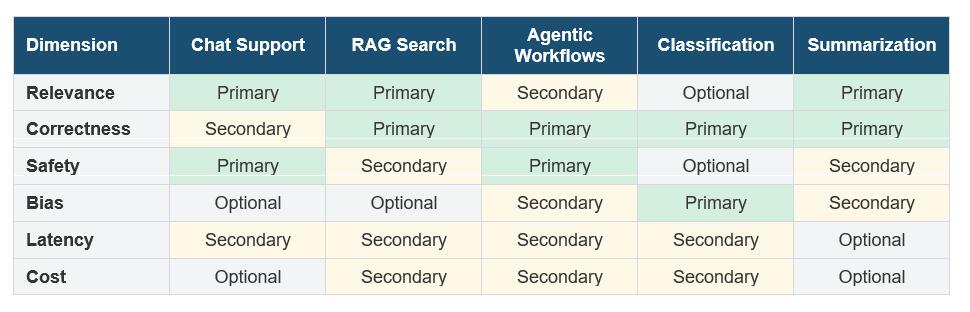
This matrix is a starting point, not a prescription. Your specific implementation context will shift priorities. A customer support chatbot in healthcare will elevate bias and correctness to primary status. A classification model used only for internal document routing may downgrade bias to optional. An agentic workflow operating in a regulated environment will treat every dimension as primary.
The key insight is directional. Not every metric deserves equal investment for every use case. Organizations that spread their evaluation resources uniformly across all dimensions for all systems end up with shallow coverage everywhere and deep coverage nowhere. The matrix helps you concentrate your evaluation investment where it matters most.
From Metrics to Operational Practice
Selecting the right metrics is necessary but not sufficient. The metrics must be operationalized through continuous monitoring, clear thresholds, and defined response procedures. Several principles guide this operationalization.
First, establish baselines before optimizing. You cannot set meaningful thresholds without understanding your system's current performance. Run your evaluation metrics against production data for a sufficient period to establish baseline distributions, then set alert thresholds based on statistically significant deviations from those baselines rather than arbitrary targets. A faithfulness score of 0.85 might be excellent for one RAG system and dangerously low for another, depending on the domain and the consequences of error. Baselines grounded in your actual production data provide the context that universal benchmarks cannot.
Second, automate evaluation wherever possible. Manual evaluation processes create bottlenecks, introduce inconsistency, and degrade over time as teams face competing priorities. Modern evaluation frameworks such as Ragas and DeepEval, along with purpose-built platforms from providers like Arize and Confident AI, enable automated evaluation pipelines that run continuously on production traffic. Integrate these into your CI/CD pipelines so that model updates are automatically evaluated before deployment. The most mature organizations treat evaluation gates with the same seriousness as security scans. No model change reaches production without passing defined evaluation thresholds.
Third, combine automated and human evaluation. Automated metrics provide scale and consistency, but they have known limitations. LLM-based evaluators, which use one language model to judge another's output, can disagree significantly with each other and with human assessments. Research has shown that different evaluator models can produce faithfulness scores ranging from 0% to over 80% on the same set of responses. Human evaluation remains essential for calibrating automated metrics, validating edge cases, and assessing subjective quality dimensions that automated tools struggle to capture. The practical recommendation is to run automated evaluation on 100% of production traffic and layer human evaluation on a statistically meaningful sample, focusing human attention on disagreements between automated evaluators and on the long-tail failure modes that automated systems tend to miss.
Fourth, monitor for drift continuously. AI system performance degrades over time as data distributions shift, user behaviors evolve, and the world changes. A model evaluated at deployment is not the same model six months later in terms of effective performance. Your evaluation framework must include ongoing drift detection that alerts you when performance metrics deviate from established baselines. This is particularly critical for classification systems where concept drift, a change in the underlying relationship between inputs and outcomes, can render a model progressively less accurate without any visible change in the input data itself. Seasonal patterns, regulatory changes, shifts in customer demographics, and competitive dynamics all contribute to drift that only continuous monitoring can detect.
Fifth, connect evaluation to governance. Evaluation metrics should feed directly into your AI governance reporting. When the AI Council or Risk Committee reviews AI system performance, they should see evaluation data that maps to the risk dimensions they care about. This connection ensures that evaluation is not an isolated technical activity but an integral component of organizational AI oversight. The evaluation matrix presented earlier provides a natural mapping between technical metrics and governance concerns. Faithfulness scores map to transparency and explainability. Bias metrics map to fairness requirements. Safety scores map to risk mitigation. Presenting evaluation data through this governance lens makes it actionable for the senior leaders who need to make decisions about AI program investments and risk appetite.
Finally, build evaluation feedback loops that drive improvement. Evaluation is not merely an audit function. The most valuable evaluation programs create tight feedback loops between metric findings and system improvements. When faithfulness scores decline in a RAG system, the evaluation data should indicate whether the problem stems from retrieval or generation quality, enabling targeted remediation. When a classification model shows emerging bias, the evaluation data should identify which segments are affected and whether the root cause is data drift or model architecture. Without these diagnostic loops, evaluation becomes a reporting exercise rather than a capability improvement engine.
Getting Started: A Practical Sequence
For organizations that have not yet built systematic evaluation capabilities, the sheer breadth of metrics can feel paralyzing. The temptation is either to measure everything superficially or to measure nothing at all. Neither approach serves you well. A practical starting sequence can help you build evaluation capabilities incrementally while delivering value at each stage.
Start with your highest-risk AI system. Identify the single AI application that carries the greatest potential for customer harm, regulatory exposure, or financial impact. This is where investment in evaluation will yield the greatest return in risk reduction. Use the matrix above to identify the primary metrics for that system’s se-case pattern, and build an automated evaluation for those dimensions first.
Next, establish your evaluation infrastructure. The tooling decisions you make for your first system will shape your evaluation capabilities for everything that follows. Invest in evaluation infrastructure that supports multiple use-case patterns rather than building point solutions for individual systems. Open-source frameworks like Ragas for RAG evaluation and DeepEval for broader LLM evaluation provide flexible foundations. Commercial platforms from Arize, Confident AI, and others offer more comprehensive capabilities, including production monitoring, drift detection, and integrations with governance reporting.
Then, extend evaluation to your broader AI portfolio. Once you have infrastructure and experience from your first system, systematically evaluate your remaining AI applications. Prioritize by risk tier, applying the most rigorous evaluation to high-risk systems and lighter-touch monitoring to lower-risk applications. This mirrors the risk-based governance approach recommended by both the EU AI Act and the NIST AI RMF.
Finally, build the organizational muscle for continuous improvement. Evaluation is not a one-time project. It is an ongoing operational discipline. Staff it accordingly. Train your teams on evaluation methodologies. Create feedback loops between evaluation findings and model improvement activities. And report evaluation results to governance forums with the same regularity and rigor you bring to financial reporting.
The Metrics You Choose Reveal the Risks You Take Seriously
Every evaluation strategy embodies a set of priorities, and by extension, a set of trade-offs. The metrics you choose to measure reflect the risks you consider most important. The metrics you choose not to measure represent risks you are implicitly accepting.
This is why the evaluation strategy should not be delegated entirely to technical teams. It requires input from business stakeholders who understand customer impact, from legal and compliance teams who understand regulatory exposure, from risk management professionals who understand organizational risk appetite, and from ethics advisors who understand the broader societal implications of AI deployment.
The organizations building the most resilient AI programs treat evaluation as a strategic capability, not a technical afterthought. They invest in evaluation infrastructure with the same seriousness they bring to model development. They staff the evaluation teams with the same talent they recruit for model building. And they hold themselves accountable to evaluation results with the same rigor they apply to financial metrics.
The metric toolbox presented here gives you a starting framework. The next step is yours. Audit your current AI systems against these dimensions. Identify the gaps between what you are measuring and what you should be measuring. Prioritize investments based on the risk profile of each use case. And build the evaluation muscle that will sustain Trusted AI as your AI portfolio grows.
Because in the end, the question is not whether your AI systems will face evaluation challenges. The question is whether you will discover those challenges through systematic measurement or through the far more expensive mechanism of customer complaints, regulatory findings, and public failures.
Measure what matters. Measure it continuously. And let the measurements drive action.