


In April, Uber reported that they'd already blown their 2026 AI coding tool budget, just four months into the year. The company actively encouraged engineers to use the tools and had leaderboards to track usage. By May, they struggled to link spend to new product features. By June, they set a $1,500-per-employee-per-month cap on each agentic coding tool, introduced a spend dashboard, and required approval to go above it.
Microsoft implemented similar measures in August. Leadership told engineers that each division now operates under a token budget, with each engineer's spending visible. Guidance indicated that engineers typically spend a few hundred to several thousand dollars per month on tokens. The company sought “more impact per token.”
Both companies have large, skilled engineering teams and can report token spending precisely. However, their reports do not show the cost or return of a completed task. Because vendors bill by token, most AI cost reports focus on tokens, which only measure input to a call. Systems track outcomes separately for tickets, claims, orders, and payments, and few reports connect costs to results.
The gap widens as agents handle more tasks. A low-cost call that fails and requires retries or human intervention can ultimately cost more than a higher-priced call that succeeds on the first attempt, yet token-based reports may favor the former. The more accurate metric is the total cost per successful task, including all associated expenses. Calculating this requires a full cost breakdown and a clear definition of success, which often changes how alternatives are ranked.
Why the Bill Keeps Rising
The cost of a fixed level of AI continues to decline. Gartner projects that by 2030, inference on a trillion-parameter model will cost providers over 90% less than in 2025. However, providers are expected to pass on only part of these savings, and total inference spending is still expected to increase.
Increased volume explains this gap. Gartner estimates that agents use 5 to 30 times more tokens than chatbots for the same task and expects agent workflow inference costs to rise more than fivefold by 2028. Agents plan, call tools, review results, self-check, and retry, sending larger contexts through the model at each step. Reasoning models also add tokens for their internal processing, which providers bill as well.
McKinsey’s research on agentic coding finds that about 60% of an agent task’s cost comes from refining answers through repeated checking and correction. Other cost drivers include context accumulation during long sessions, defaulting simple tasks to advanced models, inconsistent step counts due to vague instructions, and additional calls from orchestration when agents transfer work.
Token price alone does not reflect these factors. Even if the rate drops by half in a year, monthly invoices can double if each task consumes more tokens. Microsoft and Uber experienced this in their engineering teams, where coding agents run extended sessions on large codebases and engineers often run multiple agents simultaneously.
The Forecast Starts in the Pilot
Most AI budgets begin with a pilot, typically using a few hundred selected cases and often funded by vendor credits, with engineers closely monitoring each run. In production, the system faces higher volumes, more complex inputs, retries, longer contexts, safety checks on every call, and large-scale monitoring. These conditions don't exist during the pilot.
McKinsey’s research quantifies this increase. In a May 2026 survey, AI spending rose nearly fourfold as companies expanded from single use cases to broader adoption, and 93% of respondents reported exceeding their AI budgets. One bank’s projected AI spend grew from $4 million dollars annually to over $25 million.
Finance teams see these impacts in their forecasts. In an April 2026 Mavvrik study, only 11% could forecast AI spend within 10%, down from 15% the previous year. For 62%, unexpected AI costs influenced business decisions, 40% escalated cost surprises to the board, and 25% delayed or canceled AI projects.
Forecasts based on pilot token counts reflect pilot conditions, not production realities. A reliable forecast starts with the cost per completed task on live traffic, multiplied by expected task volume, and includes all relevant costs.
The Rest of the Bill
The token invoice is the only clearly labeled AI cost, but it represents just a fraction of total system expenses.
A working AI system pulls data through pipelines and stores it in a vector database. It incurs transfer fees to move data between clouds and regions. It runs behind a gateway and orchestration layer, sends calls to a second model for evaluation and safety checks, and writes a trace for each step. People review a sample of its work and complete the cases it fails. Engineers keep its prompts and tools current as models change.
These costs often surprise finance teams more than token charges. In a 2025 survey by Mavvrik, 56% cited data platforms, and 52% cited network charges as sources of AI cost surprises. Model token and API charges ranked fifth at 37%.
Monitoring also incurs high costs. Cisco’s 2026 State of Observability survey found that 57% of companies now spend more on telemetry than on the systems being monitored. Agents contribute by generating many steps per task, with full prompts and outputs increasing data volume. Teams can reduce costs by keeping concise, structured records of key actions and capturing full content only for sample runs, preserving necessary evidence while lowering expenses.
Some AI-related expenses are not tracked as AI costs. McKinsey estimates that 20% to 30% of AI spending is unaccounted for, often hidden in software subscriptions with bundled AI features. Mavvrik found that only 42% of engineering organizations include developer AI tools in their cost reports.
In systems where people handle failed cases, human labor is often the largest expense. Each AI failure requires manual completion, and McKinsey includes this rework in agent operating costs. In the billing desk example, the cost of resolving failed tickets is 10x the token bill.
Cost Per Successful Outcome
The key metric is total cost across all attempts in a given period, divided by the number of outcomes that meet the quality standard. McKinsey’s July research refers to this as “the completed business outcome.”
The numerator includes everything used to reach the outcome.
Tokens for every attempt, including retries and reasoning
Retrieval, storage and network charges
Evaluation and safety calls, plus monitoring
A share of the engineering time that keeps the system current
Human review, and the human time spent finishing what the AI failed
The denominator includes only outcomes that meet the quality bar. For support tickets, this means the billing system reflects the change and the customer does not return with the same issue within a set period, such as seven days. An insurance claim must pay the correct amount and pass audit. The system should generate outcome labels such as resolved, escalated, abandoned, or failed at the end of each run. Since agents may report success on work that later fails, outcome labels should not rely solely on agent reports.
The quality bar ensures the metric remains accurate. Klarna shifted most support chats to an AI assistant in 2024 and reported significant savings. But in May 2025, the company told Bloomberg that cost had become “a too predominant evaluation factor,” which reduced quality and led to renewed hiring of support staff. Measuring only lasting resolutions aligns quality and cost, so a declining resolution rate increases the cost per successful outcome.
Research on agents supports this approach. A Princeton study found that coding agents with similar accuracy could differ in cost by nearly two orders of magnitude. It recommended reporting cost alongside accuracy and optimizing both together in agent evaluations.
Vendors are beginning to price based on outcomes. Fin, the support agent from the company formerly known as Intercom, charges $0.99 per outcome. In June 2026, Salesforce introduced a help agent that bills $2 per resolution and nothing for unresolved contacts. Because each vendor defines resolution differently, buyers should establish their own definitions and data for invoice verification before contracting.
One Billing Desk, Three Designs
Consider a software company whose finance team processes 100,000 tickets monthly. About 60% are routine tasks like invoice copies and plan changes, while the remaining 40% involve more complex issues such as disputed charges and proration errors across multiple accounts. Before AI, the company handled each ticket manually at a loaded cost of $8, totaling $800,000 per month.
The company tested three designs.
Top model on every ticket
Cheaper model on every ticket
A router that sent routine tickets to the cheaper model and hard ones to the top model
The following figures are illustrative. They assume list prices of $5 and $25 per million input and output tokens for the top model, and $1 and $5 for the cheaper model, with half of input tokens served from cache at one-tenth the price. The cheaper model requires more tokens and retries, especially for complex tickets, resolving only half as many as the top model. Each failed AI ticket is handled manually at $8. Additional AI costs, including retrieval, tracing, evaluation, quality review, and engineering upkeep, total approximately $38,000 per month per design.
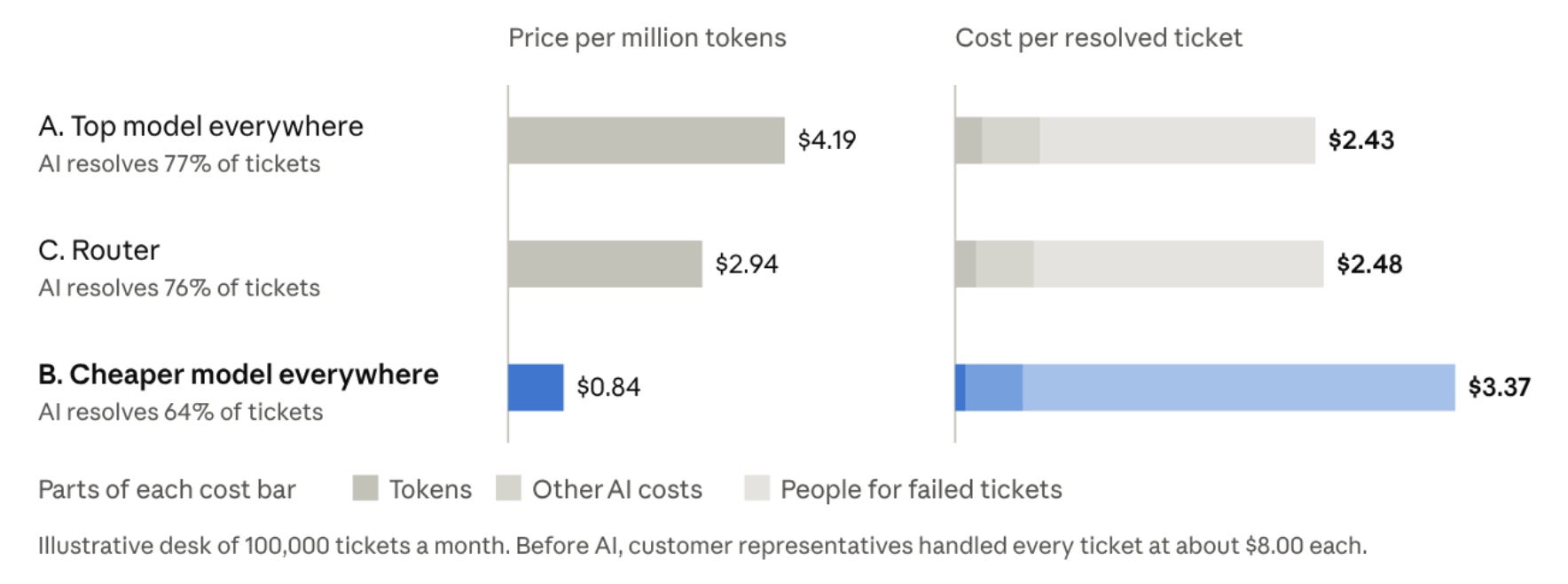
Each approach costs less than half of the previous $800,000 monthly spend. Token price rankings are the reverse of cost per resolved ticket. Design B appears most efficient by token report, at $0.84 per million tokens and a $7,300 token bill, but uses nearly twice as many tokens as Design A (8.7 billion versus 4.4 billion) due to more retries on complex tickets. Design B resolves 13,200 fewer tickets monthly than Design A, requiring manual intervention that adds about $105,600 per month, over five times Design A’s total token bill.
The token bill represents a small portion of total costs in every design. In Design A, it accounts for less than 8% of the monthly total. Other AI costs are twice as high, and manually resolving failed tickets costs 10x more.
Partial cost measures can be misleading. If a team divides only AI costs by AI resolutions and excludes manual rework, the results are about $0.70 per resolution for Design C, $0.72 for Design B, and $0.74 for Design A. This approach favors the router and the cheaper model over the top model.
The decision between Design A and Design C depends on the cheaper model’s resolution rate for routine tickets. At 86% versus 88% for the top model, the router costs about $5,600 more per month. At 87%, costs break even. If the cheaper model matches the top model on routine tasks, the router saves about $3,900 per month. Determining this requires a month of outcome labels on live traffic, segmented by ticket type.
The Controls and the Data Behind Them
McKinsey reports that about one-third of surveyed companies have reduced AI spending by 20% to 30% through active tuning. These methods rely on data that links each call to its cost and outcome, a connection most companies still haven't established.
Tie every call to an owner and an outcome
Tag each model call with the task, system, owning team, and the outcome label set at the end of the run. OpenTelemetry conventions for generative AI already include token counts and model names, so most additional effort involves business-specific fields. These fields allow cost reports to attribute costs to specific tasks.
Route by difficulty
Assign each task to the least expensive model that meets its quality standard. The RouteLLM study showed a trained router reduced costs by over half while maintaining about 95% of the stronger model’s quality on a standard benchmark.
Gartner also advises using smaller models for routine tasks and reserving advanced models for complex reasoning. In the billing desk example, the router was cost-effective only when the cheaper model resolved routine tickets at rates close to the top model, which requires outcome data segmented by task type.
Cache and batch
Providers charge as little as one-tenth the normal input price for repeated inputs served from cache, benefiting agents that resend identical instructions and documents. Tasks that can wait up to a day can be batched and processed at about half price. Both approaches require identifying which prompts repeat and which tasks can be delayed.
Trim what each call carries
Long sessions resend all previous context. Summarizing history, limiting context length, removing unnecessary tool results, and setting strict output-length limits reduce token usage at each step. Evaluate each change on real tasks before implementing it, since shorter contexts may omit necessary information.
Cap each run
Establish per-run and per-day spending limits that halt the agent and notify its owner when exceeded. The system running the agent should enforce these limits, not the agent’s instructions.
KPMG’s survey of large US companies highlights the progress still needed. Two-thirds have cost dashboards, and 36% have controls that directly manage token or usage levels. Dashboards only report spending after it occurs. Bridging this gap requires integrating controls into the systems that initiate calls, supported by data that links cost to outcomes.
Who Owns the Bill
In May and June 2026, 52% of engineering leaders surveyed by Harness reported that no one in their organization clearly owns AI costs. Platform teams, FinOps, finance, and engineering share responsibility, with no single group in charge. 72% experienced a surprise AI bill in the past year, and only 20% could identify the source of a doubled bill within hours.
Ownership of outcomes should align with ownership of costs. The billing desk leader owns the cost of resolved tickets, with FinOps providing data and engineering providing controls. The lead sets quality standards and routing rules, approves model changes, and owns monthly trends.
Budgets are more effective when based on a consistent unit. Calculating budget as expected cost per outcome multiplied by expected volume, with defined ranges, gives finance a testable monthly forecast and lets owners increase volume while maintaining cost per outcome.
Approval processes should include a comprehensive cost review. KPMG’s global survey found that just over half of companies conduct cost reviews during AI project approvals. Reviews should address expected volume, cost per outcome at that volume, the quality standard, and the system providing outcome labels.
Incentive structures require careful design. Uber tracked AI usage on leaderboards to encourage adoption, while Amazon discontinued a similar leaderboard after employees ran unnecessary AI tasks to improve their rankings, according to the Financial Times. Per-person spending caps distribute limits evenly, regardless of output. Providing teams with their cost per outcome and eventually charging back costs incentivizes greater efficiency.
Company leaders need a concise summary of these metrics: cost per outcome for major AI systems, associated volumes, the proportion of AI spend with assigned ownership, and trends for each metric.
The Roadmap
A company can implement this framework in roughly six months.
Find the full bill (weeks 1 - 4)
Aggregate AI spending from token invoices, cloud bills, data platforms, software subscriptions, and developer tools. Assign each expense to a system and owner, and record any unassigned costs.
Measure two systems (weeks 5 - 10)
Select the two largest AI systems by spend. Define success for each, apply outcome labels from the system of record, and calculate cost per outcome over a month of live traffic, segmented by task type.
Tune where the data points (weeks 11 - 18)
Test routing by segment, implement caching and context limits, batch tasks that can wait, and set run limits. Keep changes only if cost per outcome decreases and resolution rates remain stable.
Make it the budget unit (weeks 19 - 26)
Base next year’s AI budgets on cost per outcome and expected volume. Incorporate cost reviews into approval processes and report these metrics monthly to executives and quarterly to the board.
The initial step will take the most time. Spending is spread across multiple areas, often beyond any single team's view, and this process reveals systems that lack clear ownership.
The Question Finance Will Ask
KPMG’s June 2026 global survey found that 49% delayed or scaled back AI agent deployments when costs exceeded value. Only 35% could fully monitor AI operating costs. Those with full visibility were 5x more likely to report established AI returns (15% vs. 3%).
All AI programs face spending pressures, whether from budget cycles or sudden cost increases. Companies that can't quantify the cost of a successful outcome respond by capping productive users, canceling effective projects, shifting work to cheaper models that increase manual workload, or letting quality decline. These actions appear as savings in token reports.
Such companies will struggle to demonstrate the value they have created because they cannot specify the cost per unit of value.
Trusted AI is written for executives, board members and senior practitioners building, funding or overseeing AI programs. Have a topic you want covered? Reply to any issue or reach out on LinkedIn.
Sources
TechCrunch, Uber caps employee AI spending after blowing through budget in four months
Bloomberg, Uber Caps Usage of AI Tools Like Claude Code to Manage Costs
Quartz, Uber COO says AI spending is getting harder to justify
404 Media, Microsoft Tells Engineers ‘Tokenmaxxing Is Not What We Are Optimizing For’
VentureBeat, Gartner says agent costs will rise fivefold by 2028 even as tokens get cheaper
McKinsey, Is that AI agent worth it? Agentic economics and the modern operating model
McKinsey, The cost of intelligence: How CIOs can manage AI demand at scale
Mavvrik and Benchmarkit, 2026 State of AI Cost Governance Report (press release)
CFO Dive, 1 in 4 companies delay or cancel AI projects over cost
CIO, AI cost overruns are adding up, with major implications for CIOs
Cisco, Splunk State of Observability 2026: Avoiding the Hidden Costs of AI Agents
Fortune, Klarna says it’s hiring more humans after leaning hard on AI
Intercom, AI Customer Service Agent Pricing Comparison: The Complete 2026 Guide
LMSYS, RouteLLM: An Open-Source Framework for Cost-Effective LLM Routing
PPC Land, KPMG finds 49% cut AI agent rollouts when costs outran value
Harness, New Harness Report Reveals Enterprise AI Spend Has Outgrown the Systems Built to Track It