


Ask any executive whether their organization documents its AI systems, and most will say yes. Ask them to produce the documentation, and you will see a very different picture. Scattered Confluence pages written during development and never updated. Jupyter notebooks that serve as de facto records, but only data scientists can read. Slide decks from model review meetings with no traceability to what actually shipped. And for a growing number of AI systems, particularly those built on third-party foundation models or deployed through low-code platforms, no documentation at all.
This is not a minor housekeeping issue. Documentation is the connective tissue of AI governance. Without it, accountability is theoretical, transparency is performative, and compliance is aspirational. When regulators come knocking, when an AI system produces a discriminatory outcome, when a board member asks how a particular decision was made, documentation is what separates a defensible program from an organizational crisis.
The good news is that effective AI documentation does not require building an entirely new discipline from scratch. Researchers and practitioners have spent years developing standardized formats, from model cards to datasheets to decision logs, that distill the essential information stakeholders need into manageable, maintainable artifacts. The challenge has never been knowing what to document. It has been creating documentation that is concise enough for teams to actually maintain, structured enough for auditors to evaluate, and connected enough to the AI lifecycle to stay current as systems evolve.
This post provides practical templates and guidance for the documentation artifacts that form the backbone of any credible AI governance program. These are designed to be adopted immediately, applied to existing systems, and scaled as your program matures. They reflect the emerging requirements of the EU AI Act, the NIST AI Risk Management Framework, the Colorado AI Act, and ISO/IEC 42001, so that what you build today positions you for the compliance obligations arriving tomorrow.
Why Documentation Fails and How to Fix It
Before diving into specific templates, it is worth understanding why AI documentation efforts so frequently fall apart. The failure pattern is remarkably consistent across organizations, and recognizing it is the first step toward building something sustainable.
The most common failure is treating documentation as a milestone rather than a practice. Teams create thorough documentation during a model review or before a launch, then never touch it again. Within months, the documentation describes a system that no longer exists in its current form. Training data has been updated. Hyperparameters have been tuned. The model has been retrained on new data. Guardrails have been added or modified. None of these changes are reflected in the original document. When someone finally consults the documentation, whether an auditor, a new team member, or a regulator, they discover a snapshot of history rather than a description of reality.
The second failure is over-engineering. Organizations attempt comprehensive documentation frameworks that require so much effort to complete that teams either abandon them or fill them with boilerplate that satisfies the form without conveying useful information. A thirty-page model documentation template that nobody reads provides less governance value than a two-page model card that everyone understands and maintains.
The third failure is isolation. Documentation exists in one system while development happens in another. Model cards live in SharePoint while models are versioned in MLflow. Risk assessments are filed in GRC platforms that data scientists never access. Decision logs are scattered across meeting notes, email threads, and Slack conversations. When documentation is disconnected from the workflows where decisions are actually made, it becomes an administrative burden rather than a governance tool.
Effective AI documentation addresses all three failures through a simple design principle. Keep each artifact short enough to maintain, structured enough to audit, and embedded enough in daily workflows that updating it feels natural rather than burdensome.
The Documentation Stack
A comprehensive AI documentation program consists of several distinct artifact types, each serving a different audience and governance purpose. Think of these as layers in a documentation stack, where each layer answers a different question about your AI systems.
Model cards answer the questions: what does this model do, how well does it work, and what are its limitations? Data statements answer: what data was used, where did it come from, and what are its known characteristics and gaps? Decision logs answer: what governance decisions were made, by whom, and on what basis? Impact assessments answer: what are the potential harms, and how are they being mitigated? And incident records answer: what went wrong, what was the response, and what changed as a result?
Each artifact type maps to specific regulatory requirements and governance needs. Together, they create an audit trail that demonstrates not just what your AI systems do, but how they are governed throughout their lifecycle.
Model Cards
What They Are and Why They Matter
Model cards were introduced in a landmark 2019 paper by Margaret Mitchell, Timnit Gebru, and colleagues at Google as a standardized way to report the essential characteristics of machine learning models. The concept was deliberately inspired by nutrition labels: a concise, structured format that communicates critical information to stakeholders who may not have deep technical expertise.
Since then, model cards have become the most widely adopted form of AI documentation. Hugging Face requires them for every model hosted on its platform. NVIDIA has extended the concept through its Model Card++ framework, which adds safety, security, and data governance fields aligned with the EU AI Act. Amazon Web Services has embedded model card functionality directly into SageMaker. The concept has evolved from a research proposal to an industry norm.
For enterprise governance, model cards serve as the single source of truth about each AI model in your portfolio. They provide the information that compliance officers need to evaluate whether a model is suitable for its intended use, that product managers need to understand limitations, and that auditors need to verify that governance controls are operating as intended. They also satisfy a growing body of regulatory requirements. The EU AI Act’s technical documentation obligations for high-risk systems, scheduled to take full effect in August 2026, require essentially everything that a well-constructed model card contains, including descriptions of intended purpose, training methodology, performance metrics, known limitations, and evaluation procedures. The Colorado AI Act, now set to take effect at the end of June 2026, explicitly references model cards as an acceptable documentation format for the information that developers must provide to deployers.
A Practical Model Card Template
The template below is designed to fit on two pages when completed. That constraint is intentional. If your model card requires more than two pages, it is either too detailed for a summary artifact (move the detail into supporting documents and link to them) or the model is complex enough to warrant a more comprehensive technical documentation package.
MODEL CARD TEMPLATE
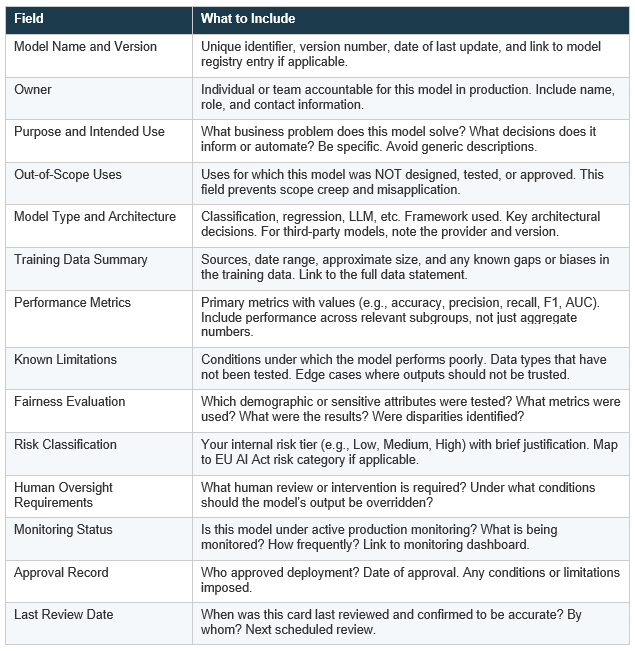
Two fields deserve special emphasis. Out-of-Scope Uses is the field most often left blank and most valuable in practice. It is the field that prevents a fraud detection model from being repurposed for credit scoring without appropriate review, or a customer service chatbot from being deployed in a clinical setting without additional validation. Be explicit and concrete about what this model should not be used for.
Performance across subgroups is equally critical. Aggregate accuracy numbers can mask significant disparities. A hiring model that is 85% accurate overall but 72% accurate for candidates from underrepresented groups presents a fairness problem that aggregate metrics will not reveal. This is precisely the kind of algorithmic discrimination that the Colorado AI Act is designed to prevent, and documenting subgroup performance is the first step toward identifying and addressing it.
Data Statements
Documenting What Your Models Learned From
If model cards describe what an AI system does, data statements describe what it learned from. Originally proposed by Emily Bender and Batya Friedman as “data statements” for natural language processing and expanded by Timnit Gebru and others as “datasheets for datasets,” these artifacts document the provenance, composition, and known characteristics of the data used to train, validate, and evaluate AI models.
Data documentation is where many governance programs have the largest gap. Teams that can describe their model architecture in detail often struggle to answer basic questions about their training data. Where did it come from? What time period does it cover? How was it labeled? Were there consent mechanisms in place? What populations are represented, and what populations are missing?
These questions are not academic. Data quality and representativeness are the primary drivers of bias in AI systems. And the regulatory landscape is increasingly focused on data governance as a compliance requirement. The EU AI Act requires high-risk AI system providers to document data governance practices, including data collection methods, data preparation processes, and assessments of data relevance and representativeness. GPAI model providers face separate obligations to publish sufficiently detailed summaries of the data used for training, including data types, sources and preprocessing methods.
A Practical Data Statement Template
DATA STATEMENT TEMPLATE
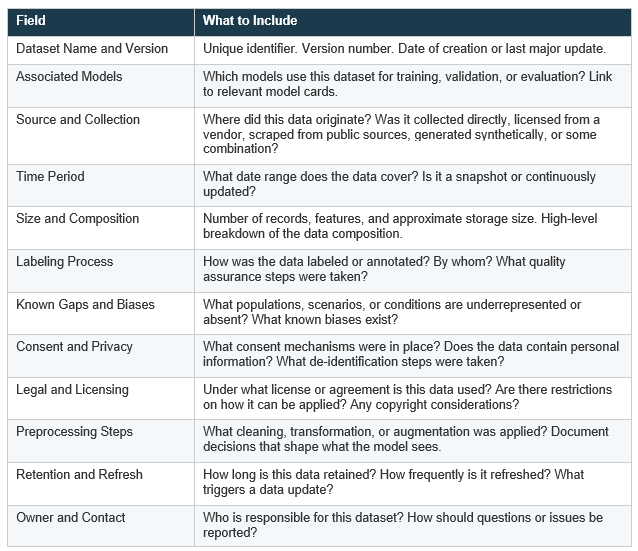
The Known Gaps and Biases field is perhaps the most important and the most difficult to complete honestly. There is an understandable organizational reluctance to document weaknesses in your own data. But this transparency is exactly what governance requires. An acknowledged gap can be mitigated. An unacknowledged gap becomes a liability, both operationally and legally.
For organizations using third-party foundation models, data documentation can be particularly challenging because you may not have visibility into the training data. In these cases, document what you know, what the model provider has disclosed, and what remains unknown. The EU AI Act addresses this by requiring GPAI providers to supply downstream deployers with technical information needed to comply with their own obligations, so pressure on providers to disclose training data characteristics will only increase.
Governance Decision Logs
Creating an Auditable Record of AI Decisions
Model cards and data statements describe the technical artifacts of your AI program. Governance decision logs describe the human decisions that shape those artifacts. They capture the who, what, when and why of AI governance actions, creating the audit trail that demonstrates active governance rather than passive compliance.
Decision logs answer questions that no other documentation artifact can. Why was this model approved for production despite a known limitation? Who decided that a particular fairness threshold was acceptable? What conditions were attached to a deployment approval? When was a risk assessment last reviewed, and what changed as a result?
These questions matter enormously in regulatory and legal contexts. The NIST AI Risk Management Framework emphasizes that governance activities must be documented and traceable, with clear records of who made decisions and on what basis. The Colorado AI Act requires deployers to document all efforts to monitor, evaluate, mitigate, and manage risks associated with their high-risk AI systems. When regulators or plaintiff attorneys come looking for evidence of governance, decision logs are what they want to see.
A Practical Decision Log Template
GOVERNANCE DECISION LOG TEMPLATE
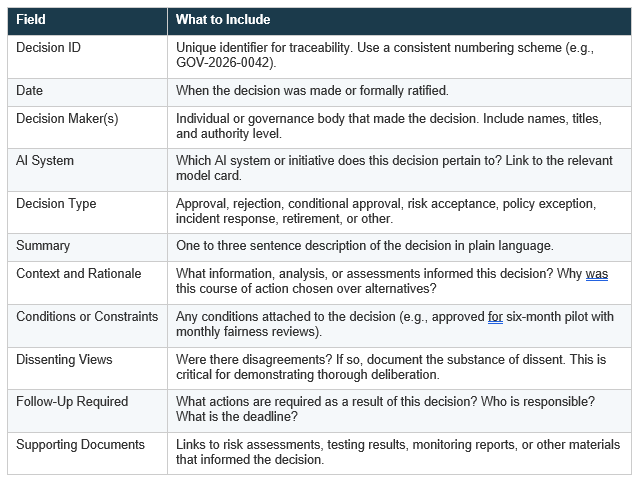
The Dissenting Views field deserves particular attention. Organizations instinctively want to present unified decisions, and recording disagreement can feel uncomfortable. But documented dissent is one of the strongest indicators of robust governance. It demonstrates that decisions were genuinely deliberated rather than rubber-stamped. It also provides essential context if a decision later proves problematic. A record showing that someone raised the concern and was overruled for documented reasons is far more defensible than a record showing that nobody noticed the problem.
Impact Assessments
From Regulatory Requirement to Governance Tool
Impact assessments evaluate the potential harms of an AI system before and during deployment. They are rapidly transitioning from best practice to legal obligation. The Colorado AI Act requires deployers of high-risk AI systems to conduct impact assessments before the law takes effect, and annually thereafter, with additional assessments required within 90 days of any significant system modification. Impact assessments must be retained for three years and produced to the Attorney General upon request. The EU AI Act imposes analogous requirements for fundamental rights impact assessments for high-risk AI systems, alongside the broader technical documentation obligations.
An impact assessment is not a one-time pre-launch activity. It is a living document that evolves with the AI system and its operating environment. The initial assessment identifies anticipated risks. Subsequent reviews evaluate whether those risks have materialized, whether new risks have emerged, and whether mitigation measures are working.
A Practical Impact Assessment Template
IMPACT ASSESSMENT TEMPLATE
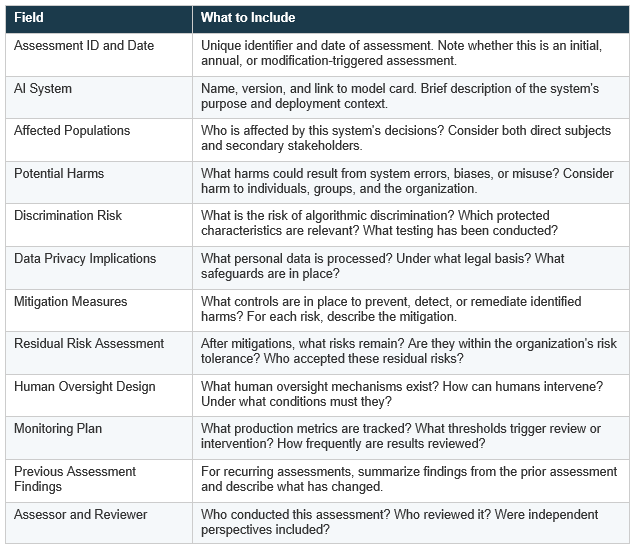
Impact assessments are where your documentation artifacts connect to form a coherent governance narrative. The model card provides the technical foundation. The data statement identifies data-related risks. The decision log records how governance bodies acted on assessment findings. Together, they tell the story of an organization that understands its AI systems and actively manages their risks.
Incident Records
Learning From What Goes Wrong
Every AI program will experience incidents. Models will degrade. Outputs will surprise. Systems will produce results that, in hindsight, should have been caught earlier. The question is not whether incidents will occur but whether your organization captures and learns from them systematically.
Incident records serve three purposes. First, they create a factual record of what happened, which is essential for regulatory reporting and legal defensibility. The EU AI Act requires providers and deployers of high-risk AI systems to report serious incidents to relevant authorities. Second, they drive immediate remediation by documenting the response and ensuring that corrective actions are tracked to completion. Third, and most importantly, they feed continuous improvement by identifying patterns and systemic weaknesses that governance processes should address.
A Practical Incident Record Template
INCIDENT RECORD TEMPLATE
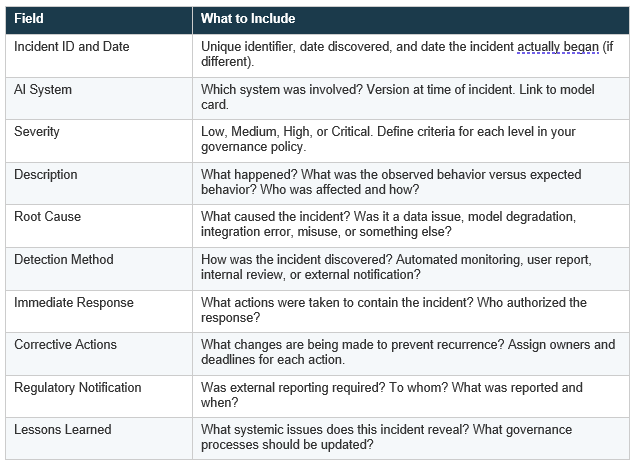
The Detection Method field provides valuable intelligence about the health of your monitoring program. If incidents are consistently discovered through user complaints rather than automated monitoring, that signals a gap in your observability infrastructure. Over time, tracking this field reveals whether your investments in production monitoring are actually catching issues before they affect stakeholders.
Connecting Documentation to the Regulatory Landscape
One of the strongest arguments for investing in documentation now is that multiple regulatory frameworks are converging on similar requirements, and organizations that build their documentation practice today will be positioned to comply with obligations arriving on a compressed timeline.
The EU AI Act’s high-risk system requirements take full effect on August 2, 2026. These include detailed technical documentation covering system description, intended purpose, design specifications, training data, evaluation procedures, performance metrics, and risk management measures. The Act’s Annex IV specifies documentation requirements in granular detail, and the penalty structure is severe, reaching up to 35 million euros or 7% of global annual turnover for the most serious violations.
The Colorado AI Act, following its postponement during the 2025 special session, is currently set to take effect on June 30, 2026. It requires developers to make available documentation, explicitly referencing artifacts such as model cards and dataset cards, and requires deployers to conduct and retain impact assessments. Notably, the Act provides an affirmative defense for organizations that can demonstrate compliance with the NIST AI Risk Management Framework or ISO/IEC 42001, creating a direct incentive to align your documentation with these frameworks now.
The NIST AI RMF, while voluntary, is increasingly referenced by regulators as a compliance benchmark. Its GOVERN function explicitly calls for legal and regulatory requirements to be understood, managed, and documented. The March 2025 updates to the framework added emphasis on model provenance, data integrity, and third-party model assessment, reflecting the reality that most organizations now rely on external AI components in their systems. NIST is expected to release version 1.1 guidance and expanded profiles through 2026, and the framework’s integration into state-level safe harbor provisions means that NIST alignment is becoming a practical necessity for risk mitigation.
ISO/IEC 42001 provides the certifiable management system standard for AI governance. Organizations seeking third-party validation of their governance practices will find that the documentation artifacts described in this post map directly to ISO/IEC 42001’s requirements for documented information, risk assessment, and management review records. Certification requires evidence that your AI management system is not just designed but actively operating, and documentation is that evidence.
Making Documentation Sustainable
The best documentation framework in the world is worthless if it is not maintained. Sustainability requires intentional design choices that reduce friction and integrate documentation into the natural flow of AI development and operations.
Automate What You Can
Many model card fields, such as performance metrics, training data characteristics, and version information, can be populated automatically from your ML platform. Organizations like Datatonic have demonstrated how model card and data card updates can be embedded directly into training pipelines, so that every time a model is retrained, the documentation updates automatically. If your teams are using platforms like MLflow, Weights & Biases, or Amazon SageMaker, explore the built-in documentation features and invest in connecting them to your governance artifacts.
Assign Clear Ownership
Every documentation artifact needs an owner who is accountable for its accuracy. For model cards, that owner is typically the model owner or product owner identified in your governance operating model. For data statements, it is the data owner or steward. For decision logs, it is the secretary of the governance body that made the decision. Ownership should be explicit in the artifact itself, not assumed.
Build Review Cadences
Documentation should be reviewed on a regular cadence, not just when someone asks for it. Quarterly reviews for high-risk systems and annual reviews for lower-risk applications are reasonable starting points. Tie review dates to your governance calendar so that documentation reviews coincide with the governance forums where findings can be discussed and acted upon.
Start With Your Highest-Risk Systems
You do not need to document every AI system simultaneously. Begin with the systems that present the greatest risk, whether because they affect consequential decisions about individuals, operate in regulated domains, or have the largest potential for reputational harm. Documenting your top five to ten highest-risk AI systems creates immediate governance value and provides a practical test bed for refining your templates before broader rollout.
Keep It Connected
Documentation artifacts should link to each other. Model cards should reference data statements. Impact assessments should link to model cards. Decision logs should reference the assessments that informed them. Incident records should link back to the systems involved and forward to the governance decisions made in response. This interconnection transforms individual documents into a governance system, where any stakeholder can trace the full history of an AI system from data provenance through deployment decisions to production monitoring.
Getting Started This Week
If your organization does not yet have a systematic AI documentation practice, here is a practical path to start building one immediately.
First, inventory what exists. Before creating new documentation, audit what you already have. Many organizations have more documentation than they realize, but it is scattered, inconsistent, and incomplete. Gather existing model documentation, risk assessments, and deployment records into a central view. Identify the gaps.
Second, adopt the templates in this post as starting points. They are designed to be used as-is for most enterprise AI systems. Customize the fields to reflect your organization’s specific risk categories, governance structures, and regulatory requirements, but resist the temptation to add complexity before you have validated the basics.
Third, pick three systems and document them now. Choose your highest-risk or most consequential AI systems and create model cards, data statements, and (if applicable) impact assessments for them this month. The act of completing the documentation for real systems will reveal which fields are valuable, which need refinement, and where your information gaps are.
Fourth, present the documentation to your governance body. Use the completed artifacts as the basis for a governance review. This serves two purposes: it validates the documentation quality with stakeholders, and it demonstrates the governance value of structured documentation in a concrete way that builds organizational support for the program.
Fifth, build the maintenance process. Define who owns each artifact, when it is reviewed, and what triggers an update. Embed documentation checkpoints into your deployment pipeline so that no model reaches production without a current model card and, for high-risk systems, a current impact assessment.
The Competitive Value of Good Documentation
Documentation is often framed as a compliance obligation, something you do because regulators require it. That framing undersells its strategic value considerably.
Organizations with strong AI documentation practices move faster because teams spend less time reconstructing context and more time building. They scale more effectively because new team members can onboard to existing AI systems without relying on tribal knowledge. They negotiate better with partners and customers because they can demonstrate governance maturity with evidence rather than assertions. And they are positioned to enter regulated markets and win enterprise contracts that require demonstrable AI governance, an advantage that will compound as regulatory requirements expand globally.
The organizations capturing AI’s full potential are not the ones with the most sophisticated models. They are the ones that can explain what their models do, demonstrate how they are governed, and prove that they operate as intended. Documentation is how you make that proof tangible.
The question, as always, is whether you will build these capabilities proactively on your own terms, or reactively when a regulator, auditor, or customer demands them. The templates are here. The regulatory deadlines are approaching. Start now.
Extremely useful and practical info. Automation seems a key component of making governance successful, any thoughts on what platforms could be leveraged to do so?