


Every organization deploying AI today faces the same fundamental challenge: how to transform aspirational principles like fairness, accountability and transparency into operational reality. The gap between intention and implementation is where AI programs fail, where regulatory exposure grows, and where trust erodes.
Operationalizing AI ethics requires a practical blueprint, and companies need to move beyond abstract frameworks to deliver specific policies, standards, and decision criteria that can be implemented immediately. The organizations that master this translation will separate themselves from competitors still struggling to reconcile principle with practice.
The Translation Problem
Consider a principle that appears in virtually every AI ethics framework: AI systems should be fair and non-discriminatory. At first glance, this seems straightforward. In practice, it raises immediate questions that principles alone cannot answer.
• How do you define fairness when different definitions are mathematically incompatible?
• What threshold of demographic disparity triggers remediation?
• Who has the authority to approve the deployment of a model with known bias tradeoffs?
• How frequently must you re-evaluate fairness as data distributions shift?
These are not philosophical questions. They are operational decisions that must be made consistently across your organization every time an AI system moves from development to production. Without explicit policies and standards, each team will interpret principles differently, creating inconsistency, risk exposure, and governance gaps.
The Operationalization Framework
Translating principles into practice requires a structured approach that connects abstract values to concrete actions. We recommend a four-layer framework that progressively increases specificity.
Principles - Aspirational values that guide organizational intent. (ex. “Our AI systems will be fair and non-discriminatory.”)
Policies - Organizational commitments that mandate specific behaviors. (ex. “All high-risk AI must undergo bias testing before deployment.”)
Standards - Technical specifications that define acceptable performance. (ex. “Demographic parity ratios must fall within the 0.8-1.25 range.”)
Decision Criteria - Specific rules that determine go/no-go decisions. (ex. “Models exceeding thresholds require VP-level exception approval.”)
Each layer adds the necessary operational specificity to support governance and mitigate risk. Principles without policies are merely suggestions; policies without standards cannot be measured; and standards without decision criteria cannot be enforced. The complete stack creates 360-degree accountability.
The organizations that master the translation
from principles to practice will lead their industries.
Those who do not will find themselves
managing crises rather than opportunities.
Operationalizing Fairness
Fairness is perhaps the most challenging principle to operationalize because it requires making explicit choices between competing definitions. Research has demonstrated that different mathematical definitions of fairness, such as demographic parity, equalized odds and calibration, are often mutually incompatible. Your organization must choose which definition applies in which context.
Policy Requirements
These standard policy requirements establish a structured approach for ensuring fairness in AI systems throughout their lifecycle:
1. All AI systems that make or inform decisions about individuals must be classified by impact tier (Critical, High, Medium, Low) based on potential for harm.
2. Critical and High-tier systems require documented fairness analysis before deployment, including selection and justification of fairness metrics appropriate to the use case.
3. Fairness testing must evaluate outcomes across legally protected categories and additional categories identified through stakeholder analysis.
4. Production systems must be monitored for fairness drift with alerting thresholds defined at deployment.
The policies are not intended to be one-size-fits-all and should be tailored to the particulars of the use case and the organization's culture.
Technical Standards
Quantitative thresholds provide the measurement foundation for fairness governance. Similar to the policy requirements, the baseline standards should be calibrated to your specific regulatory environment and risk tolerance.
Demographic Parity Ratio: Threshold is 0.80 to 1.25; applied to selection and approval decisions.
Equalized Odds Difference: Threshold is less than 0.10; applied to risk scoring systems.
Calibration Gap: Threshold is less than 0.05; applied to probability predictions.
Decision Criteria
Establishing clear decision criteria is essential for ensuring the responsible deployment of AI models. The following guidelines outline how fairness thresholds and risk metrics should inform the path to model approval, escalation, and ongoing accountability. By adhering to these criteria, organizations can promote transparency, regulatory compliance, and ethical oversight throughout the lifecycle of AI systems.
Models meeting all fairness thresholds: Proceed to deployment with standard monitoring.
Models with single metric exceedance < 20% over threshold: Require a documented mitigation plan and business justification; approval authority at the Director level.
Models with multiple exceedances or any exceedance > 20%: Require formal exception review by the AI Ethics Committee with documented business necessity and harm mitigation.
Models with exceedances in legally protected categories: Mandatory legal review before any exception consideration.
Operationalizing Accountability
Accountability requires clear ownership at every stage of the AI lifecycle. The principle that “someone is responsible” must translate into specific roles with defined authorities, escalation paths, and consequences.
Policy Requirements
Detailed policy requirements establish concrete expectations for accountability and oversight in the management of AI systems.
Every AI system must have a designated Accountable Owner with authority to approve deployment, mandate changes, or order decommissioning.
Accountability must be documented in a system registry accessible to governance, audit, and regulatory functions.
Changes in ownership require a formal handoff with documented acceptance of accountability.
Accountable Owners are responsible for ensuring ongoing compliance with all applicable policies and standards.
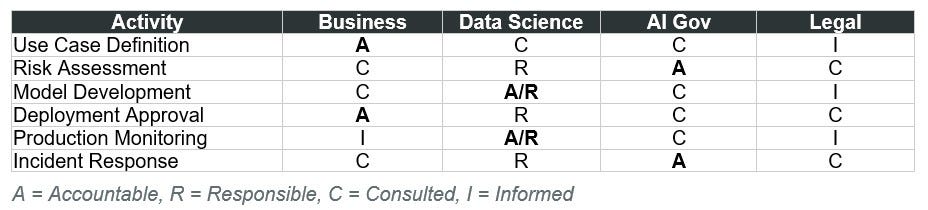
RACI Framework for AI Systems
To ensure these accountability measures are effectively implemented, it is essential to clarify roles and responsibilities throughout the AI system’s lifecycle. The RACI framework provides a structured approach for assigning and communicating these responsibilities within your organization. The following represents a baseline that should be adapted to your organizational structure.
Operationalizing Privacy
AI systems pose unique privacy challenges. They can infer sensitive information from seemingly innocuous data, perpetuate data beyond its intended retention period through model embeddings, and make re-identification of anonymized data more feasible. Privacy operationalization must address these AI-specific risks alongside traditional data protection requirements.
Policy Requirements
These are designed to ensure robust privacy protection and regulatory compliance throughout the lifecycle of AI systems.
All AI training data must undergo a Privacy Impact Assessment (PIA) with a documented legal basis for processing.
AI systems must implement data minimization—collecting and retaining only data necessary for the specified purpose.
Sensitive personal data (health, biometrics, political opinions, etc.) requires enhanced controls and explicit approval for AI use.
AI systems must support data subjects’ rights, including access, correction, and deletion, accounting for the implications of model retraining.
Cross-border data transfers for AI training or inference must comply with applicable transfer mechanisms.
Technical Standards
To translate policy into actionable safeguards, the technical standards outline concrete measures for protecting privacy in AI system development and operations.
Training Data: Implement differential privacy with epsilon ≤ 1.0 for systems processing sensitive data.
Anonymization: Apply k-anonymity (k ≥ 5) for structured data; evaluate re-identification risk for unstructured data.
Retention: Training data must be deleted or anonymized within 24 months unless explicit extended retention is justified and approved.
Inference Logging: Production inference logs must be anonymized within 90 days; raw logs retained only for documented troubleshooting purposes.
Model Unlearning: Establish procedures for removing individual data contributions from trained models upon verified deletion requests.
Decision Criteria
To ensure responsible handling of data in AI systems, the following decision criteria establish clear guidance for processing and approving data based on its sensitivity and intended use.
Standard Processing: Standard PIA approval is sufficient for low-sensitivity data with a documented legal basis.
Sensitive Data: Processing requires DPO/CPO approval, enhanced technical controls, and documented necessity.
Novel Data Uses: New purposes for existing data require an updated PIA and a fresh legal basis assessment.
Third-Party Data: External data sources require vendor privacy due diligence and contractual protections.
Operationalizing Security
AI systems introduce novel attack surfaces that traditional security frameworks do not address. Data poisoning, model extraction, adversarial inputs, and prompt injection represent AI-specific threats requiring dedicated controls.
Policy Requirements
To safeguard data integrity and mitigate unique risks associated with AI technologies, the policy requirements outline essential security measures for all AI systems.
All AI systems must undergo security threat modeling to address AI-specific vulnerabilities before deployment.
Model artifacts (weights, configurations, training data, etc.) must be classified as sensitive assets with appropriate access controls.
Production AI systems must implement input validation and output filtering appropriate to their risk tier.
AI systems must maintain audit logs sufficient for incident investigation and forensic analysis.
Third-party AI components (APIs, models, libraries) require security assessment and ongoing vulnerability monitoring.
Technical Standards
Security controls should be calibrated to the risk tier. The following represents the minimum requirements by tier.

Operationalizing Sustainability
AI systems have significant environmental footprints. Training large models can produce carbon emissions equivalent to hundreds of transatlantic flights. As AI scales across the enterprise, organizations must account for and manage these environmental impacts.
Policy Requirements
To address the environmental impact of AI systems, organizations must implement the policy requirements to ensure responsible and sustainable operations.
All AI initiatives must include environmental impact assessment as part of project approval.
Training compute must be tracked and reported for carbon accounting purposes.
New model training should evaluate efficiency alternatives (smaller models, distillation, transfer learning) before proceeding with large-scale training.
Cloud infrastructure should prioritize regions with renewable energy where latency requirements permit.
Technical Standards
Proposed technical standards help outline the concrete practices and metrics organizations must adopt to effectively monitor and minimize the environmental impact of their AI systems.
Compute Efficiency: Track and report FLOPs/inference and compare against benchmarks for equivalent capability.
Carbon Measurement: Implement carbon tracking using tools like CodeCarbon or cloud provider sustainability dashboards.
Model Right-Sizing: Establish benchmarks for acceptable compute per capability level and require justification for exceeding benchmarks.
Hardware Lifecycle: Consider embodied carbon in hardware procurement and establish refresh cycles that balance efficiency gains against manufacturing impacts.
Decision Criteria
To define the approval pathways and review requirements based on the compute and carbon impact of AI projects, robust decision criteria are used.
Standard Approval: Projects with compute requirements within established benchmarks for the use case category.
Enhanced Review: Projects exceeding category benchmarks by >2x require sustainability justification and efficiency roadmap.
Executive Approval: Projects with estimated carbon impact exceeding defined annual thresholds require C-suite sign-off with an offset/mitigation plan.
Building the Governance Infrastructure
Policies and standards require adequate infrastructure to support adherence. This means governance bodies with authority, processes that integrate with existing workflows, and tools that enable compliance verification.
Governance Bodies
Effective AI governance relies on well-defined bodies, each with clear roles and responsibilities to ensure policies are enforced and risks are managed appropriately.
AI Ethics Committee: Senior cross-functional body (Legal, Risk, Technology, Business, HR) that owns policy development, exception review, and escalated decisions. The group should meet at least monthly with the authority to halt deployments.
AI Center of Excellence: A technical body responsible for developing standards, creating reference implementations, and providing guidance to project teams. They maintain the AI system registry and monitoring infrastructure.
AI Risk Function: Integration with enterprise risk management ensures AI risks are assessed, tracked, and reported alongside other business risks. It provides second-line oversight of AI activities.
Process Integration
AI governance must integrate with existing enterprise processes to avoid creating parallel workflows that teams will circumvent. Critical integration points include:
Project Intake: AI risk assessment integrated into project initiation—no AI project proceeds without initial classification.
Development Lifecycle: Governance checkpoints embedded in CI/CD pipelines—automated policy checks block non-compliant deployments.
Change Management: AI model updates are treated as changes requiring appropriate review and approval.
Vendor Management: AI-specific due diligence requirements incorporated into procurement processes.
Incident Management: AI incidents routed through established incident response with AI-specific playbooks.
Enabling Technology
Manual governance does not scale. Organizations need tooling to automate compliance verification and monitoring.
AI Registry: Centralized inventory of all AI systems with ownership, risk classification, and compliance status.
Policy-as-Code: Automated policy checks integrated into deployment pipelines that enforce standards without manual intervention.
Observability Platform: Production monitoring for performance, fairness, drift, and security with automated alerting.
Audit Trail: Immutable logging of model versions, training data provenance, and deployment decisions.
Implementation Roadmap
Operationalizing AI ethics is not a one-time project but a capability-building journey. A phased approach that delivers early value while building toward comprehensive governance is recommended.
Phase 1: Foundation (Months 1-3)
Conduct an AI inventory to identify all current and planned AI systems.
Establish an AI Ethics Committee with executive sponsorship and cross-functional membership.
Develop a risk classification framework and classify existing systems.
Create an initial policy set covering the highest-risk applications.
Identify quick wins with high-visibility improvements that demonstrate value.
Phase 2: Operationalization (Months 4-8)
Develop comprehensive standards for each principle area.
Integrate governance checkpoints into development and deployment workflows.
Deploy initial observability tooling for high-risk production systems.
Establish a training program and begin organization-wide AI literacy development.
Create AI risk reporting for executive and board visibility.
Phase 3: Maturation (Months 9-12+)
Implement policy-as-code for automated compliance verification.
Extend observability to all production AI systems.
Conduct internal and external audits to validate governance effectiveness.
Establish a continuous improvement process based on incident learnings and emerging requirements.
Prepare for regulatory compliance (EU AI Act and emerging frameworks).
Conclusion: From Aspiration to Execution
The gap between AI ethics principles and operational practice is where trust is built or broken. Organizations that close this gap will deploy AI with confidence, move faster than competitors constrained by uncertainty, and build the stakeholder trust needed to enable ambitious AI initiatives.
The framework presented here is not theoretical. It reflects patterns from organizations that have successfully operationalized AI governance. Companies that now treat AI ethics not as a constraint but as an accelerant.
Start with your highest-risk AI systems. Establish clear ownership. Define specific, measurable standards. Build monitoring that provides continuous visibility. Create decision criteria that enable consistent action.
The organizations that master the translation from principles to practice will lead their industries. Those who do not will find themselves managing crises rather than opportunities.