


Every organization deploying AI at scale eventually confronts the same uncomfortable question: Who is actually in charge of this?
In too many enterprises, the answer is nobody, or worse, everybody. AI initiatives proliferate across business units, each with its own informal processes and varying degrees of rigor. Data science teams build models with minimal oversight. Product managers deploy AI features without clear accountability for outcomes. Risk and compliance functions scramble to catch up, often discovering issues only after they have materialized in production.
This governance vacuum is not sustainable. As AI becomes embedded in increasingly consequential decisions, such as who gets hired, who receives credit, and what medical treatments are recommended, the absence of clear accountability structures creates unacceptable risk. Yet the solution is not to layer on bureaucracy that stifles innovation. The organizations getting AI governance right have discovered that thoughtful structure actually accelerates AI value creation by reducing uncertainty, building stakeholder confidence, and enabling faster progression from pilot to production.
The challenge is designing an operating model that provides sufficient oversight without becoming a bottleneck. This requires careful consideration of roles, decision rights, and governance forums. The organizational architecture determines how AI decisions get made and who can be held responsible for outcomes.
The Operating Model Imperative
An AI governance operating model is the organizational design that specifies how governance activities are performed, by whom, and through what mechanisms. It translates abstract principles, including transparency, accountability, fairness and ethics, into concrete responsibilities and workflows. Without it, governance remains aspirational rather than operational.
The stakes are significant. Organizations with mature governance frameworks report 55% improvement in regulatory compliance and 60% increase in stakeholder trust. Yet while 80% of organizations have established AI ethics guidelines, only 25% have operationalized them. This gap between policy creation and practical application is precisely what a well-designed operating model closes.
Effective operating models share several characteristics. They establish clear ownership and accountability at every level. They create appropriate checkpoints without introducing unnecessary friction. They scale with organizational AI maturity, starting simple and evolving as capabilities grow. And they integrate with existing enterprise governance rather than creating parallel structures that fragment oversight.
The Four Pillars of Governance Design
Before defining specific roles and forums, it is essential to understand the foundational principles that any AI governance operating model must address. The four pillars of Transparency, Accountability, Fairness and Ethics form the normative foundation upon which organizational structures are built.
Transparency: Making AI Understandable
Transparency requires that organizations can explain how their AI systems work, what data they use, and how they reach their decisions. This is not merely a technical challenge of model interpretability. It is an organizational commitment to disclosure and documentation. Research indicates that 83% of companies exploring or deploying AI say being able to explain how their AI reached a decision is essential to their business.
Your operating model must define who is responsible for creating and maintaining documentation, what level of explanation is required for different risk categories, and how transparency commitments are verified in practice. This includes maintaining model cards that describe intended use and limitations, establishing processes for responding to stakeholder inquiries about AI decisions, and ensuring that marketing claims about AI capabilities are accurate and substantiated.
Accountability: Ensuring Someone Is Responsible
Accountability means that every AI system has clearly defined ownership and that individuals can be held responsible for outcomes. This sounds straightforward, but it proves surprisingly difficult in practice. AI systems often span multiple teams, from data engineering and model development to product management and operations, making it easy for accountability to diffuse across organizational boundaries.
The operating model must establish unambiguous ownership at three levels: (1) strategic accountability for the overall AI program, typically held by a senior executive; (2) tactical accountability for individual AI systems and their performance; and (3) operational accountability for day-to-day monitoring and incident response. Critically, accountability must carry real consequences, both positive and negative, to be meaningful.
Fairness: Preventing Bias and Discrimination
Fairness requires that AI systems avoid perpetuating or amplifying discrimination. Bias can emerge at any point in the AI lifecycle, from data collection and labeling, through model design and training, to deployment and ongoing operation. And because bias often reflects historical inequities embedded in training data, it can be invisible to teams that are not actively looking for it.
Your operating model should specify who is responsible for fairness assessments, what metrics and testing approaches are required, and how fairness considerations are balanced against other performance objectives. This includes defining protected characteristics that must be monitored, establishing thresholds for acceptable disparate impact, and creating escalation paths when fairness issues are identified.
Ethics: Aligning with Human Values
Ethics encompasses the broader question of whether AI applications align with organizational values and societal expectations. Some use cases may be technically feasible and legally permissible but still raise legitimate ethical concerns, including surveillance applications, manipulative design patterns, or systems that undermine human autonomy.
The operating model should establish mechanisms for ethical review of AI use cases, particularly those that are novel or high-stakes. This does not mean creating an ethics committee that reviews every AI project. Rather, it means defining criteria that trigger ethical review and establishing the expertise and authority needed to make difficult judgment calls.
Essential Roles in AI Governance
With foundational principles established, the specific roles that constitute an effective governance operating model can be detailed. The goal is not to create new bureaucratic positions but to assign clear responsibilities, often to existing roles, and ensure that governance activities have dedicated ownership.
Executive Sponsor and Strategic Accountability
Every AI governance program requires executive sponsorship with the authority and visibility to drive organizational change. Many organizations are creating dedicated roles, such as Chief AI Officer, Head of Responsible AI or VP of AI Strategy, to provide this focus. Others assign AI governance to existing executives, including the Chief Technology Officer, Chief Data Officer, or Chief Risk Officer.
The specific title matters less than the scope of responsibility. The executive sponsor sets governance strategy, secures resources, and represents AI governance in leadership forums. They are accountable to the board for AI risk management and are empowered to halt AI initiatives that pose unacceptable risk. Microsoft’s Office of Responsible AI reports directly to the President, reflecting the strategic importance the company places on governance.
AI Product and System Owners
Each AI system should have a designated owner who is accountable for its performance, compliance, and outcomes throughout its lifecycle. This role typically resides within the business unit that deploys the AI system, not within a centralized AI or technology function. The logic is straightforward. Those closest to the use case and affected stakeholders are best positioned to assess risk and make context-appropriate decisions.
AI product owners are responsible for defining and documenting the intended use of the AI system, conducting risk assessments and obtaining required approvals, ensuring appropriate testing and validation before deployment, monitoring production performance and responding to incidents, and managing the system through its lifecycle, including updates and retirement. This accountability should be explicit in job descriptions and performance evaluations to ensure it carries weight.
Technical and Data Science Leadership
Technical leaders, including heads of data science, machine learning engineering or AI platforms, are accountable for the technical infrastructure that enables governance. This includes establishing development standards and best practices, implementing tooling for model documentation, testing, and monitoring, ensuring technical talent has appropriate training in responsible AI practices, and maintaining the observability infrastructure that provides visibility into production AI behavior.
Technical leaders also serve as advisors to governance bodies, translating complex technical considerations into terms that business stakeholders can evaluate. Their role is not to make governance decisions unilaterally but to ensure those decisions are informed by deep technical understanding.
Risk and Compliance Functions
Existing risk management and compliance functions should extend their scope to encompass AI-specific risks rather than operating as separate silos. This integration ensures that AI risks are assessed alongside other enterprise risks and that governance activities leverage existing compliance infrastructure.
Risk and compliance teams provide independent assessments of AI risks, develop and maintain AI-specific policies and standards, support regulatory compliance, including preparation for requirements like the EU AI Act, and conduct or coordinate audits of AI systems and governance processes. The key is ensuring these functions have sufficient AI literacy to perform their oversight role effectively, which is a gap that many organizations are actively addressing through training and specialized hiring.
Legal and Privacy Counsel
Legal and privacy teams play essential roles in AI governance, particularly as regulatory requirements proliferate. They advise on the legal implications of AI use cases, ensure compliance with data protection and privacy requirements, assess intellectual property considerations in AI development, and support contract negotiations with AI vendors and partners.
As AI regulation matures, legal involvement in governance processes will become increasingly important. Organizations should invest in building AI-specific legal expertise, whether through internal development or external partnerships.
Ethics Advisors and Subject Matter Experts
Some organizations establish dedicated ethics roles or draw on external ethics advisors to provide an independent perspective on difficult questions. These individuals bring philosophical frameworks and stakeholder perspectives that complement technical and business viewpoints.
Ethics advisors are particularly valuable for novel use cases where established precedent is lacking, decisions that involve significant value trade-offs, and situations where affected stakeholders may have limited voice in organizational processes. Not every organization needs full-time ethics staff, but access to ethics expertise, whether internal or external, is increasingly important as AI applications grow in scope and consequence.
Decision Rights: Who Decides What
Defining roles is necessary but not sufficient. An effective operating model must also specify decision rights and define who has the authority to make particular types of decisions. Without clear decision rights, governance processes become forums for discussion rather than mechanisms for action.
Tiered Decision Authority
Organizations benefit from tiered decision authority that matches the level of risk to the level of oversight. A risk-based approach might structure decision authority as follows:
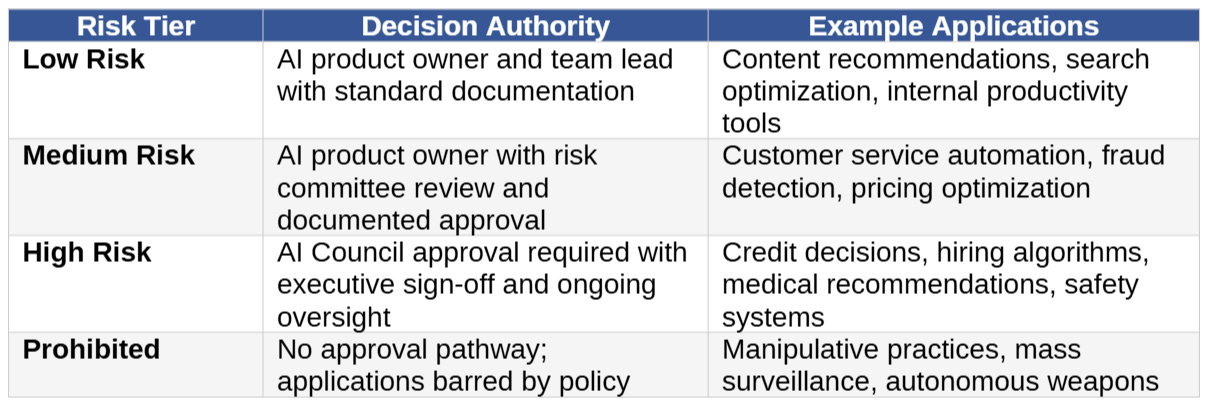
This tiered approach ensures that low-risk applications can proceed with minimal friction while high-stakes decisions receive appropriate scrutiny. The specific criteria for each tier should reflect your organization’s risk tolerance, regulatory context, and the nature of affected stakeholders.
Escalation Paths and Exception Handling
Decision rights must include clear escalation paths for situations that fall outside normal parameters. This includes edge cases where risk classification is uncertain, disagreements between stakeholders that cannot be resolved at the working level, time-sensitive decisions that require expedited review, and incidents or emerging issues that require immediate attention.
Escalation paths should specify who has authority to make expedited decisions, when escalation is required, what documentation must accompany escalated decisions, and how exceptions are tracked and reviewed to identify systemic issues. Organizations should resist the temptation to escalate everything; effective governance depends on empowering lower levels to make appropriate decisions within defined boundaries.
Veto Authority and Override Mechanisms
Some decisions require the ability to halt AI initiatives, even over the objections of business sponsors. This veto authority is essential for governance to be meaningful, but it must be exercised judiciously to maintain organizational trust.
Typically, veto authority resides with the executive sponsor, the AI Council for high-risk decisions, and specialized functions, such as legal and compliance, for their respective domains of expertise. Override mechanisms should also exist, allowing business leaders to appeal veto decisions to a higher authority when they believe the assessment is incorrect. This ensures that governance does not become unaccountable or immune from challenge.
Governance Forums: Where Decisions Happen
Roles and decision rights must be exercised through structured forums that bring together relevant stakeholders, enable informed deliberation, and produce documented decisions. The specific forums required depend on organizational scale and complexity, but most mature programs include some combination of the following groups.
The AI Council
The AI Council is the primary governance body for enterprise AI strategy and oversight. It typically includes senior representatives from technology, business units, risk, legal, and ethics, providing the cross-functional perspective needed to evaluate AI initiatives holistically.
The AI Council sets enterprise AI strategy and priorities, approves high-risk AI applications and significant investments, reviews AI program performance and risk posture, and ensures alignment between AI initiatives and organizational values. Meeting cadence varies by organization, but monthly or quarterly sessions are common, with provisions for ad-hoc meetings when urgent matters arise. IBM’s AI Ethics Board exemplifies this model, providing centralized governance and decision-making for AI-related policies, products, research, and services across the enterprise.
AI Risk Committee
The AI Risk Committee operates as a subset or extension of the enterprise risk committee, focusing specifically on AI-related risks. This forum conducts risk assessments for medium and high-risk AI applications, reviews monitoring data and incident reports, evaluates emerging risks and regulatory developments, and recommends risk mitigation strategies to the AI Council.
The Risk Committee typically meets more frequently than the AI Council, often weekly or biweekly, to provide timely oversight of AI operations. Membership should include risk management, compliance, technology, and representatives from business units with significant AI deployments.
Product and Technical Review Boards
Product and technical review boards evaluate specific AI systems and initiatives at key lifecycle stages. These reviews assess technical design and architecture decisions, evaluate testing results and performance metrics, verify that governance requirements have been satisfied, and provide go/no-go recommendations for deployment.
Review boards should include technical experts who can evaluate AI systems in depth, as well as representatives from affected business areas. The goal is to catch issues before deployment rather than after, making these forums critical checkpoints in the AI development lifecycle.
Board-Level Oversight
The board of directors is ultimately accountable for AI governance, yet surveys reveal that only 14% of boards discuss AI at every meeting, while 45% have not addressed AI at all. This gap between AI’s strategic importance and board engagement represents a significant governance risk.
Effective board oversight includes regular briefings on AI strategy and risk posture, reviews of significant AI incidents and remediation, approvals of enterprise AI policies and risk appetite, and assessments of AI governance program maturity. The executive sponsor should provide board reporting that translates technical complexity into governance-relevant insights, enabling directors to fulfill their oversight responsibilities effectively.
Integration with Enterprise Functions
AI governance does not operate in isolation. Effective operating models integrate with existing enterprise functions rather than creating parallel structures that fragment oversight and create gaps.
Risk Management Integration
AI risks should be incorporated into the enterprise risk register and assessed using consistent methodologies. This ensures that AI risks are visible alongside other business risks and that resource allocation reflects relative risk priorities. Google employs a structured four-phase approach to AI governance that integrates governance into enterprise risk management, ensuring that AI risks are not treated as separate or exceptional.
Data Governance Alignment
AI governance and data governance are deeply intertwined. AI systems depend on data quality, and data used for AI training is subject to privacy and consent requirements. The operating model should clarify the relationship between AI and data governance functions, ensuring coordinated oversight of data collection and use, consistent application of data quality standards, integrated privacy compliance across AI and non-AI contexts, and shared infrastructure for metadata management and lineage tracking.
Technology Governance Coordination
AI systems are technology systems, subject to the same security, reliability, and operational requirements as other technology assets. AI governance should align with IT governance processes for architecture review, change management, and incident response. This coordination prevents duplication, leverages existing capabilities, and ensures that AI-specific requirements are integrated into technology operations.
Human Resources Connection
AI systems that affect employees, whether in hiring, performance management, or workforce planning, require coordination with human resources functions. HR brings an essential perspective on employment law, employee relations, and organizational impact. Similarly, AI literacy requirements under regulations like the EU AI Act necessitate training programs that HR is well-positioned to develop and deliver.
Making Governance Lightweight but Effective
The most significant risk in designing an AI governance operating model is creating bureaucracy that impedes rather than enables. Organizations that succeed in scaling AI governance share several practices that keep governance lightweight while maintaining effectiveness.
Right-Size Governance to Risk
Not every AI application requires the same level of oversight. A risk-based approach allocates governance resources proportionally, applying rigorous controls to high-risk applications while enabling low-risk initiatives to proceed with minimal friction. The EU AI Act and NIST AI Risk Management Framework both embody this principle, and organizations should calibrate their governance processes accordingly.
Automate Where Possible
Many governance activities can be supported or automated through technology. Model documentation can be generated automatically from development environments. Risk assessments can leverage standardized templates and scoring frameworks. Production monitoring can provide continuous visibility without manual review. Investing in governance tooling reduces the burden on development teams while improving coverage and consistency.
Embed Governance in Workflows
Governance requirements that exist outside everyday workflows tend to be overlooked or treated as afterthoughts. The most effective approach embeds governance checkpoints directly into development and deployment processes, making compliance the path of least resistance. This might include governance templates integrated into project initiation, automated gates in CI/CD pipelines that verify required documentation, and monitoring dashboards that surface issues without requiring manual review.
Invest in Culture and Capability
Ultimately, governance effectiveness depends on organizational culture. When employees understand why governance matters and are equipped with the skills to fulfill their responsibilities, compliance becomes natural rather than burdensome. This requires sustained investment in training and communication, visible commitment from leadership, recognition of governance contributions in performance management, and creating psychological safety to raise concerns without fear of reprisal.
Start Simple and Evolve
Organizations at early stages of AI maturity should resist the temptation to implement comprehensive governance frameworks immediately. Start with the essential elements, such as clear ownership, basic risk assessment, and fundamental documentation, and add sophistication as AI capabilities and governance experience grow. An operating model that is too complex for current needs will be ignored or circumvented.
Continuous Improvement and Adaptation
An AI governance operating model is not a static artifact to be designed once and forgotten. It requires ongoing evaluation and refinement as the organization’s AI capabilities evolve, regulatory requirements change, and lessons are learned from governance activities.
Metrics and Measurement
Effective governance requires metrics that track both efficiency and effectiveness. Useful measures include time from AI initiative proposal to production deployment, number and severity of AI incidents, compliance rates with governance requirements, stakeholder satisfaction with governance processes, and coverage of AI systems under active monitoring. These metrics should be reviewed regularly and used to identify opportunities for improvement.
Lessons Learned and Feedback Loops
Every AI incident, near-miss, or governance challenge provides an opportunity to improve. Establish processes for conducting post-incident reviews, gathering feedback from AI teams about governance friction, and incorporating lessons learned into policies and procedures. The goal is continuous improvement, not perfection from the start.
Regulatory Monitoring and Adaptation
The regulatory landscape for AI is evolving rapidly. The EU AI Act represents just the beginning of comprehensive AI regulation, with additional requirements expected from jurisdictions worldwide. Your operating model should include mechanisms for monitoring regulatory developments, assessing their implications, and adapting governance processes accordingly.
The Path Forward
Designing an AI governance operating model is foundational work that determines whether governance will be a strategic enabler or an organizational burden. The organizations getting it right recognize several truths. First, governance is not antithetical to innovation but essential for sustainable AI success. Second, clear accountability at every level is non-negotiable. Third, the right forums and decision rights enable rather than impede progress. Fourth, integration with existing enterprise functions prevents fragmentation.
The investment in thoughtful governance design pays dividends in reduced risk, accelerated value realization, and stakeholder trust. As AI becomes more consequential to business outcomes, organizations with mature governance operating models will be positioned to move faster and with greater confidence than those still struggling to establish basic accountability.
Begin by assessing your current state. Map existing AI systems and identify ownership gaps. Evaluate your governance forums and decision rights. Identify the integration points that require attention. Then design an operating model scaled to your current maturity level, with a roadmap for evolution as capabilities grow.
The question is not whether your organization needs an AI governance operating model. The question is whether you will design it deliberately or let it emerge haphazardly from the gaps between existing structures. The former path leads to trusted AI at scale. The latter leads to the governance vacuum that puts AI programs and organizations at risk.
The time to act is now.