


Why Auditors Struggle with AI, and Why That Is Your Problem
Your auditors know how to evaluate access controls, encryption standards, and incident response plans. They have spent years building expertise around SOC 2, ISO 27001, HIPAA, and PCI DSS. They understand the language of controls, evidence, and risk registers. Then you deploy an AI system, and the conversation breaks down.
This is not a criticism of your audit team. It is a structural problem. Most compliance and audit frameworks were built for deterministic software systems in which inputs produce predictable outputs, logic can be inspected in the source code, and failures follow patterns that humans can trace. AI systems violate nearly all of these assumptions. They learn from data rather than execute static instructions. They can produce different outputs from identical inputs. Their decision logic is often opaque even to the engineers who built them. And their behavior degrades over time as the real world drifts away from their training data.
The result is a dangerous gap. Organizations are deploying AI systems into consequential business processes. At the same time, their audit and compliance functions lack the vocabulary, control structures, and evidence frameworks needed to assess whether those systems operate responsibly. Research from PwC confirms that AI introduces risk categories not addressed by standard control matrices, from data drift and bias to explainability and misuse. Meanwhile, NIST has acknowledged that traditional IT security controls alone are insufficient for AI and launched its Control Overlays for Securing AI Systems (COSAiS) project in August 2025 to bridge this gap.
The good news is that you do not need to invent a new compliance program from scratch. You need to extend the one you already have. The organizations getting this right are translating AI risks into the same language their auditors already speak: controls with clear owners, defined testing procedures, and documented evidence. This post shows you how to do exactly that.
Start from Your Current Control Framework, Not from AI Hype
The most common mistake organizations make when approaching AI governance is treating it as an entirely new discipline that requires entirely new infrastructure. They hire an AI ethics team that operates independently from risk management. They build AI governance documentation that exists outside the enterprise control framework. They create review processes that run in parallel with, rather than are integrated into, existing compliance workflows.
This approach fails for two reasons. First, it creates duplicative work that neither the AI team nor the compliance team wants to maintain. Second, and more importantly, it makes AI governance invisible to the auditors who are already assessing your organization. If your AI controls live in a separate system from your SOC 2 or ISO 27001 controls, your auditors will not see them, will not test them, and will not give you credit for them.
The better approach starts with a simple question: what control framework are we already using? For most organizations, the answer will be one or more of the following: SOC 2 Trust Services Criteria, ISO 27001 Annex A controls, NIST SP 800-53 control catalog, NIST Cybersecurity Framework, or a combination mapped across these standards. The AICPA has documented approximately 80% overlap between SOC 2 and ISO 27001, and the mapping relationships across NIST frameworks are well established. Your AI controls should plug directly into this existing structure.
NIST itself has endorsed this integration-first approach. Its COSAiS project is developing AI-specific overlays for SP 800-53 precisely because, as the project description states, the overlays are designed to address specific risks associated with different types of AI usage in conjunction with an organization’s cybersecurity risk management program and existing control implementations. The overlays assume that foundational controls such as access management, account management, and authentication are already in place. They add AI-specific tailoring on top.
ISO/IEC 42001, the first certifiable AI management system standard, follows the same philosophy. It uses the Plan-Do-Check-Act methodology that organizations already apply through ISO 27001, and it is designed to integrate with other management system standards rather than replace them. As ISACA recently noted, ISO/IEC 42001 aligns AI governance with other management systems, making it easier to fold new AI controls, metrics, and reviews into existing audit cadences and evidence repositories.
The practical implication is straightforward. Open your current control register. Identify the control families that are most relevant to AI risk. Then, determine where you need to add AI-specific sub-controls or modify existing control descriptions to account for AI behavior. Do not build a parallel universe.
A Practical AI Risk Taxonomy Your Auditors Will Understand
Before you can write controls, you need to agree on what risks those controls are meant to address. This is where many organizations stumble. Academic AI risk taxonomies can be extraordinarily detailed, with some frameworks defining over fifty distinct sub-threats across nine domains. That level of granularity is valuable for AI security researchers. It is overwhelming for an audit partner to understand your risk landscape during a one-hour walkthrough.
What you need instead is a practical taxonomy that maps AI-specific risks to categories your auditors already work with. The following six-category framework is designed to do exactly that. Each category is grounded in established risk domains, maps to recognized framework elements, and translates into controls that compliance professionals can evaluate.
Category 1: Data Integrity and Provenance
This covers risks associated with the data that AI systems consume, learn from, and generate. It includes training data quality and representativeness, data poisoning by malicious actors, unauthorized use of protected or copyrighted data, inadequate data lineage and documentation, and privacy violations through data repurposing. Your auditors already understand data governance through SOC 2 processing integrity criteria and ISO 27001 information classification controls. AI data risks extend these concepts to encompass training pipelines, data labeling, and the provenance of third-party datasets.
Category 2: Model Reliability and Performance
This addresses whether AI systems produce outputs that are accurate, consistent, and fit for purpose. It includes model accuracy degradation over time, concept drift and data distribution drift, hallucination in generative AI systems, performance variability across different input populations, and failure to generalize beyond training conditions. For auditors, this maps to the reliability dimension of operational risk. The key difference from traditional software is that AI performance is probabilistic rather than deterministic, and it changes without anyone modifying the code.
Category 3: Fairness and Bias
This encompasses risks that AI systems produce discriminatory or inequitable outcomes across demographic groups. It includes representational harm from biased training data, allocational harm in which resources or opportunities are unfairly distributed, proxy discrimination via correlated features, and algorithmic amplification of existing inequities. This is the category that most frequently makes headlines and triggers regulatory action. It aligns with existing anti-discrimination obligations, employment law requirements, and fair lending regulations. Still, it also requires AI-specific testing and monitoring controls that most compliance programs have not yet developed.
Category 4: Security and Adversarial Resilience
This covers the attack surface unique to AI systems beyond traditional cybersecurity threats. It includes prompt injection and jailbreaking of large language models, adversarial inputs designed to cause misclassification, model theft or extraction through inference attacks, supply chain risks from third-party models and components, and shadow AI usage by employees outside sanctioned channels. Auditors understand security controls deeply. The extension here is recognizing that AI systems introduce novel attack vectors, such as data poisoning and prompt manipulation, that firewalls and encryption alone cannot address.
Category 5: Transparency and Explainability
This addresses the organization’s ability to explain how AI systems work and how they reach their outputs. It includes documentation of the model's purpose, limitations, and intended use; the ability to provide explanations for individual decisions when required; disclosure to affected individuals that AI is being used; auditability of the decision logic and contributing factors; and documentation of known limitations and failure modes. Research consistently shows that 83% of companies deploying AI consider explainability essential to their business. For auditors, transparency controls create the documentation trail they need to evaluate other controls. Without adequate documentation, nothing else is testable.
Category 6: Governance and Accountability
This covers the organizational structures that ensure responsible AI oversight. It includes ownership assignment for every AI system, defined approval and escalation processes, lifecycle management from development through retirement, incident response procedures specific to AI failures, and third-party AI vendor management. This category maps directly to the governance and oversight domains in every major compliance framework. The challenge is ensuring that AI-specific responsibilities are explicitly assigned rather than assumed to fall under existing IT governance.
This taxonomy is deliberately concise. It covers the essential risk landscape without requiring auditors to learn an entirely new discipline. Each category connects to existing compliance concepts while highlighting what is genuinely different about AI.
Turning AI Risks into Explicit Controls, Owners, and Evidence
A risk taxonomy tells you what can go wrong. Controls tell you what you will do about it. The discipline of writing effective controls is well established in the compliance world: each control should have a clear description, an assigned owner, a defined testing procedure, specified evidence requirements, and a link to the risk it mitigates. AI controls follow the same structure. They simply address different failure modes.
The following examples illustrate how risks from each taxonomy category translate into auditable controls. These are not exhaustive but demonstrate the pattern.
Data Integrity Controls
For training data quality, the control might state that all datasets used for model training or fine-tuning are documented in a data registry that records the source, collection method, date of acquisition, known limitations, and applicable usage rights. The owner would be the head of data engineering or an equivalent role. The evidence would include the data registry itself, acquisition records, and usage authorization documentation. The testing procedure would involve the auditor sampling entries from the registry, verifying completeness against the defined schema, and then tracing a sample of training datasets back to their source documentation.
For data privacy in AI contexts, the control might require that personal data used in AI training undergo a privacy impact assessment that evaluates consent basis, purpose limitation, and data minimization requirements specific to AI processing. The owner would be the privacy officer or data protection lead. Evidence would include completed privacy impact assessments and the decision register documenting approval or rejection of data use.
Model Reliability Controls
For performance monitoring, the control could specify that all production AI models are monitored against defined performance thresholds, with automated alerts when metrics breach acceptable ranges, and that monitoring reports are reviewed at a defined cadence. The owner would be the ML engineering lead or model operations team. Evidence would include monitoring dashboard configurations, alert threshold definitions, sample alert logs, and review meeting minutes. This is where observability platforms like Arize, Evidently AI, and Fiddler become part of your evidence trail, not just your engineering toolkit.
For drift detection, the control might require that statistical tests for data distribution drift and concept drift are run at defined intervals for all production models, with documented escalation procedures when drift exceeds defined thresholds. The owner would be the data science team lead. Evidence would include drift detection reports, threshold documentation, and records of remediation actions taken upon detection of drift.
Fairness Controls
For bias assessment, the control could state that before deployment, all AI systems that make or inform decisions affecting individuals are tested for disparate impact across defined protected characteristics, with results documented and reviewed by a designated approver. The owner would be the AI product owner, with review by the risk committee. Evidence would include pre-deployment bias test results, the definition of protected characteristics tested, acceptance thresholds, and the approver’s sign-off.
Security Controls
For prompt injection prevention, the control might specify that generative AI systems exposed to user inputs implement input validation, output filtering, and system prompt protection mechanisms, and that these mechanisms are tested through adversarial testing before deployment and at regular intervals. The owner would be the application security team. Evidence would include adversarial test plans and results, input validation configuration documentation, and records of periodic re-testing.
Transparency Controls
For model documentation, the control could require that every production AI system maintain a model card or equivalent documentation that describes its intended use, training data characteristics, performance metrics, known limitations, and conditions under which it should not be used. The owner would be the AI product owner. Evidence would include completed model cards and a review log showing they are updated at defined intervals. NIST’s COSAiS project has specifically identified model documentation as a foundational element of AI security overlays, meaning this control will become increasingly expected by auditors as standards mature.
Governance Controls
For AI system inventory, the control might state that the organization maintains a comprehensive inventory of all AI systems in production or development, including third-party AI services, with defined metadata fields including risk classification, owner, deployment status, and last review date. The owner would be the Chief AI Officer, CTO, or equivalent. Evidence would include the AI inventory register, verification of completeness against procurement records and code repositories, and last-review documentation.
The pattern across all of these controls follows a consistent formula. Identify the risk. Write a control statement that describes the required behavior. Assign an owner who is accountable for the control operating effectively. Define the evidence that proves the control is working. Specify how an auditor would test it. This is not conceptually different from how you already manage access control or change management controls. You are simply applying the same discipline to AI-specific risks.
Plugging AI into Your Existing Security and Privacy Programs
With risk categories defined and controls drafted, the next challenge is integration. AI governance should not create a parallel compliance structure. It should extend the structures you already operate. Here is how to map AI controls into the major frameworks.
SOC 2 Integration
SOC 2’s Trust Services Criteria provide natural extension points for AI controls. Security (Common Criteria) already covers access controls, system operations, and change management. AI extensions include access controls for model artifacts, training data, and inference endpoints, as well as change management procedures that encompass model retraining and deployment. Availability criteria extend to AI system uptime, failover, and graceful degradation when models underperform. Processing Integrity is perhaps the most relevant criterion, covering accuracy, completeness, and timeliness of system processing. AI-specific controls for model accuracy monitoring, drift detection, and output validation map directly here. Confidentiality and Privacy criteria also cover AI-specific concerns such as training data, model memorization, and inference-time data exposure.
The practical advantage is that your SOC 2 auditor already tests these criteria. By framing AI controls as extensions of existing criteria rather than novel requirements, you make them testable within your existing audit cycle. You are not asking your auditor to learn a new framework. You are asking them to evaluate additional controls within a framework they already know.
ISO 27001 Integration
ISO 27001’s Annex A controls similarly accommodate AI extension. Asset management controls expand to include AI models, training datasets, and configuration artifacts as information assets. Access control extends to model registries, training pipelines, and inference APIs. Supplier management is expanding to encompass third-party AI model providers, including evaluations of their security practices, training data handling, and model update procedures.
For organizations pursuing both ISO 27001 and ISO 42001, the integration is even more direct. ISO 42001 was designed to interoperate with ISO 27001, and certification bodies are increasingly offering combined audits. Deloitte has noted that the ISO 42001 approach to AI management builds upon control frameworks that many organizations already have in place, including data governance, IT, security, privacy, enterprise risk management, and internal audit.
NIST SP 800-53 Integration
For organizations using NIST SP 800-53, the path forward is being paved by NIST itself through the COSAiS project. The overlays will address four major use cases: adapting and using generative AI with large language models; automating business workflows with predictive AI; single- and multi-agent AI systems; and controls for AI developers. Each overlay will tailor the existing 800-53 controls to address AI-specific concerns such as model integrity, data provenance, adversarial robustness, and transparency. Organizations using 800-53 today should monitor this project closely, as it will provide the most authoritative mapping between traditional security controls and AI-specific requirements.
Privacy Program Integration
AI systems present privacy challenges that extend beyond traditional data processing. Models can memorize and regurgitate training data. They can infer sensitive attributes from seemingly innocuous inputs. They create new personal data through classification and prediction. Your privacy program should extend data protection impact assessments to cover AI training and inference. Consent management processes should address whether individuals consented to AI processing specifically, not just data collection generally. Data subject rights procedures should account for the right to an explanation and the right not to be subject to solely automated decision-making under regulations such as GDPR.
The Unified Control Register
The goal of this integration exercise is a single control register, or a unified view across registers, where AI controls sit alongside security and privacy controls. When an auditor opens your control register, they should see AI controls in context, mapped to the same risk categories, using the same ownership model, and producing the same types of evidence as every other control in your program.
A Simple Template: One-Page AI Control Register for Auditors
What follows is a template for a one-page AI control summary that you can hand to your auditor for any AI system. This is not a replacement for detailed control documentation. It is a communication tool that provides auditors with the entry point they need to understand how your AI governance aligns with their testing program.
The template captures six fields for each AI system. First, AI System Identification, including the system name, a brief description of its function, the risk tier classification (low, medium, high, or prohibited), the designated system owner, and the deployment date and last review date. Second, the Risk and Control Summary, which is a table mapping each applicable risk category to the specific control, the control owner, the evidence type, and the framework mapping (such as SOC 2 CC7.2 or ISO 27001 A.12.4). Third, Data Governance, documenting training data sources, privacy assessment status, data retention and deletion policies, and third-party data agreements. Fourth, Monitoring and Observability, specifying the performance metrics tracked, drift detection methods and frequency, alerting thresholds and escalation paths, and the last monitoring review date. Fifth, Testing and Validation, including pre-deployment test results with dates, bias and fairness assessment results, adversarial and red team testing results, and scheduled re-testing cadence. Sixth, Incident History and Remediation, recording any AI-specific incidents, root cause analysis, and remediation actions taken, and any resulting control modifications.
The risk and control summary table is the centerpiece. Here is what it looks like for a hypothetical customer service chatbot powered by an LLM.
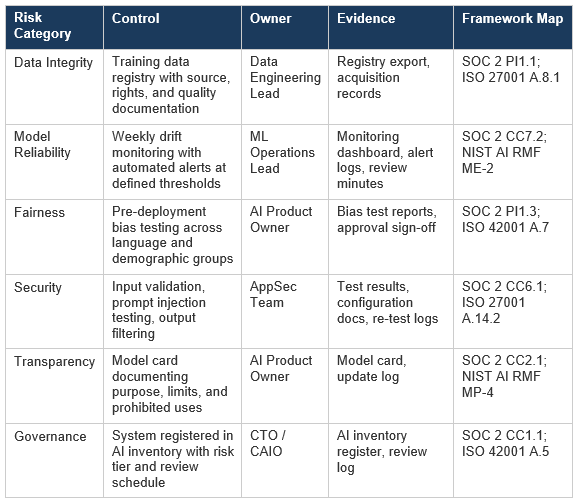
This single page gives your auditor a complete map of the AI system, the risks it presents, the controls in place, who owns them, what evidence exists, and how it all connects to the frameworks they are already testing. It transforms a conversation that might otherwise devolve into a machine-learning tutorial into a structured compliance discussion in terms both parties understand.
One practical note on evidence. The shift from traditional software controls to AI controls often requires new categories of evidence that auditors have not previously evaluated. Model monitoring dashboards, drift detection reports, bias testing results, and adversarial test logs are not yet standard audit artifacts. When you introduce these to your auditor, provide context. A one-page guide explaining what each type of evidence shows, how it is generated, and what good looks like will save hours of back-and-forth during fieldwork.
How to Pilot This for One AI Use Case in 30 Days
If you have read this far, you understand the framework. The question now is how to start. Here is a 30-day pilot plan that takes one AI use case from uncontrolled to audit-ready.
Days 1 through 5: Select and scope
Choose one production AI system, ideally one that is high enough risk to be meaningful but well enough understood to be manageable. A customer-facing chatbot, a fraud detection model, or an AI-assisted underwriting system is a good candidate. Document its purpose, data inputs, decision scope, and affected stakeholders. Assign an owner if one is not already defined.
Days 6 through 10: Assess risks and map to existing controls
Walk through the six-category taxonomy with the system owner and relevant technical leads. For each category, identify which risks are applicable and which existing controls already provide partial coverage. Document gaps where no controls currently exist. Pull up your current control register and note where AI-specific extensions are needed.
Days 11 through 18: Draft controls and assign owners
For each identified gap, draft a control statement following the formula described in Section 3. Assign an owner for each control. Define the evidence each control should produce and confirm that the evidence is either already being generated or can be generated with reasonable effort. Do not let perfection be the enemy of progress. A basic monitoring control with weekly manual review is better than a fully automated pipeline that will take six months to build.
Days 19 through 25: Collect and organize evidence
Gather evidence for each control. This is where you discover whether your controls are actually operational or merely aspirational. If you cannot produce evidence that a control is working, the control is not working. Common findings at this stage include monitoring tools configured but not reviewed, documentation that exists but is outdated, and ownership defined on paper but not exercised in practice. Address what you can and document what needs remediation.
Days 26 through 30: Package and review
Complete the one-page AI control register template for your pilot system. Share it with your internal audit team or compliance lead and ask them to evaluate it as an external auditor would. Their feedback will reveal gaps in clarity, evidence sufficiency, and framework mapping. Incorporate their input and finalize the template.
At the end of 30 days, you will have a working example of an AI control set that auditors can evaluate, a template that can be replicated across your AI portfolio, and a concrete understanding of the gaps between your current governance posture and what audit-ready AI governance requires. Just as important, you will have started the conversation between your AI teams and your compliance teams in a shared language.
The Bottom Line
AI governance does not need its own compliance religion. It needs to speak the language that your organization’s risk infrastructure already understands. The control frameworks are already there. The audit relationships are already there. The evidence management systems are already there. What is missing is the translation layer that connects AI-specific risks to these existing structures.
NIST recognized this when it chose to build AI security overlays atop SP 800-53 rather than create something entirely new. ISO recognized it by designing ISO 42001 to integrate with ISO 27001. The organizations that move fastest will be those that follow this same logic: extend what exists, do not rebuild from nothing.
The window for proactive action is narrowing. The EU AI Act’s requirements continue to phase in through 2027. NIST is actively developing AI-specific control overlays that auditors will soon reference. SOC 2 auditors are already beginning to ask questions about AI systems within existing engagements. The organizations that have their AI control sets defined, documented, and integrated will answer those questions with confidence. The organizations that do not will find themselves in the reactive, expensive position of having to retrofit governance under pressure.
Start with one system. Build the template. Prove the pattern. Then scale it across your AI portfolio. The goal is not to create a perfect AI governance program overnight. The goal is to establish the structure that makes responsible AI auditable, scalable, and sustainable.
Policy alone cannot deliver trusted AI. You also need controls that auditors can test, evidence they can evaluate, and owners they can talk to. Build that bridge, and you will find that AI governance becomes less of a burden and more of a capability that accelerates everything else.