


One technology failure repeats across enterprise after enterprise, reliably enough to count as a pattern rather than a run of bad luck. A team builds an AI assistant for the customer support organization. It demos beautifully, answering in seconds the kind of question that used to take an agent five minutes to research, and leadership greenlights a rollout to the whole department. For two weeks, the dashboards look excellent. Then, on a single busy afternoon, the assistant confidently tells three agents something about a refund policy that turns out to be wrong, and one of those answers reaches a customer before anyone catches it. Word travels through the team faster than any training memo. Within a month, usage has fallen by more than half. The agents have quietly gone back to the old knowledge base because checking the assistant’s work took longer than not using it at all. The model was not broken. The engineering was sound. What failed was trust, and the feature is now on the list of things that did not pan out.
Here is the uncomfortable part. The organization in that story almost certainly had a governance program in place. It had principles, a policy document, perhaps a review board. None of it prevented the outcome because governance lived in one part of the company and the product in another. The policy outlined what the AI was supposed to do. It did nothing to make the product something people would actually rely on. That is the thesis worth sitting with.
In most enterprises, the Trusted AI program built to make AI safe is doing almost nothing to drive adoption, and the way it is built is often part of why adoption fails.
This is not a small problem hiding in a corner. McKinsey’s 2025 State of AI research found that 88% of organizations now use AI in at least one business function, yet only a sliver, around 5%, report that AI is driving significant, enterprise-level financial impact. The distance between near-universal adoption and realized value is not primarily a model gap or a talent gap. It is a trust gap. Organizations are deploying capabilities that their users will not lean on, that their customers do not feel comfortable with, and that their own risk functions cannot see into.
The mechanism behind the failure is almost always the same. Trust gets written by the governance function and handed to product teams as a set of constraints. Policies arrive after the build is already underway. Reviews feel like a tax. The people who actually decide what ships experience trust as friction rather than as something that helps them win, so they tolerate it at best and route around it at worst. A program designed that way protects the company on paper while quietly starving it of the adoption that was the entire reason for building the AI in the first place.
The strategies that work invert this completely. They make trust legible in the language product teams already speak, build it into the work rather than around it, and measure it alongside the outcomes those teams are accountable for. Trust stops being something product teams must comply with and becomes something they want because it moves the numbers they are already chasing.
Trust Has Become a Product Requirement
For most of software history, reliability was something you earned through testing and then largely took for granted. A button either worked or it did not. Quality assurance caught the cases that did not, and once a feature shipped clean, users could assume it would behave the same way tomorrow as it did today.
Emerging AI features break that assumption. They are probabilistic rather than deterministic. They can be confidently wrong. They behave differently as input data drifts away from what they were trained on, and they can produce outputs no one on the team anticipated. A feature that is right 92% of the time is not the same as a feature that works 92% of the time, because that 8% is not evenly distributed or a minor difference. If those failures are visible, high stakes, or hard to recover from, they will define the user’s experience of the entire feature.
This is why trust now sits upstream of the build rather than downstream. It is not a compliance topic to be resolved before a public launch. It is a precondition for the feature delivering value at all because a feature people do not rely on does not produce outcomes, no matter how impressive it is under the hood.
The cost of getting this wrong shows up in the metrics every product leader watches. Weak adoption comes first, as users try a feature once, get burned, and never return. Churn follows in subscription and platform businesses, where a single bad answer in a high-stakes moment can end a relationship that took years to build. Support burden climbs because every confidently wrong output becomes a ticket, an escalation, or a frustrated call. And rollout slows to a crawl, because risk, legal, and security functions are right to hesitate when they cannot see what a system is actually doing in production. Low trust is not one problem. It is a tax levied across the entire value chain of the feature.
The external picture reinforces the internal one. McKinsey’s 2025 research found that 47% of organizations have already experienced at least one negative consequence from generative AI. PwC’s customer experience work found that well over half of consumers are only somewhat comfortable, or not comfortable at all, using AI tools to engage with brands. PwC’s executive surveys tell a parallel story, with only about a third of CEOs reporting a high degree of trust in embedding AI into their key processes. The audience for your AI features, internal and external alike, arrives skeptical. Capability does not overcome that skepticism. Demonstrated reliability does.
A documented case shows how literal that cost can become. In early 2024, the British Columbia Civil Resolution Tribunal found Air Canada liable after its website chatbot told a grieving customer he could claim a retroactive bereavement discount, which was not the airline’s actual policy. Air Canada argued, remarkably, that the chatbot was a separate entity it should not be held responsible for, and that the customer should have verified the policy on another page of the same website. The tribunal rejected that, ruling that a company is accountable for what its AI tells its customers and that relying on the chatbot was entirely reasonable. The direct damages were small, a few hundred dollars. The lasting cost was everything around them. The case has become the example that commentators now reach for when explaining why a confidently wrong AI answer is a liability rather than a quirk, and no organization wants its brand cast in that role. A single unreliable output, left ungoverned at the point of use, turned an ordinary support feature into a cautionary tale that has outlived the refund many times over.
The most useful way to hold all of this is to treat trust as the conversion rate of capability into value. Raw capability is potential. Trust determines how much of that potential turns into adoption, retention, and measurable outcomes. A strategy that improves trust is not slowing the business down in the name of responsibility. It is widening the channel through which AI capabilities translate into business results.
Define Trust in the Language Product Teams Already Speak
The single most common mistake in Trusted AI strategy is to define trust in the vocabulary of ethics and compliance and then wonder why product teams do not prioritize it. Fairness, transparency, accountability, and human oversight are essential principles that matter. But a product manager planning a quarter is optimizing for adoption, activation, retention, conversion, and efficiency. If trust is expressed only as a moral or regulatory obligation, it will lose every prioritization fight to a feature that visibly moves one of those numbers.
The way through is to recognize that, for an AI feature, trust is not separate from those metrics. It is the hidden variable underneath them.
Consider activation. A new user’s first interaction with an AI feature is a test. If the first result is wrong, irrelevant or impossible to act on without double-checking, a user forms a judgment that is very hard to reverse. First run reliability is activation. Consider retention, which depends on users coming back, and users come back to things they can depend on. One memorable failure in a consequential moment outweighs many quiet successes. Consider conversion in any revenue-facing flow, where a hallucinated price, an incorrect product recommendation, or a fabricated policy detail does not merely cause the sale to be lost. It teaches the customer not to trust the channel. And consider efficiency, the core promise behind most enterprise AI. An assistant who produces output that a person has to verify line by line, or redo from scratch, is not saving time. Net efficiency is a function of how often the user can act on the output without checking it.
That last point deserves to be stated plainly because it reframes the whole conversation. The accuracy that matters to the business is not the model’s benchmark accuracy. It is the rate at which a user can act on an output without independently verifying it. That number is at once a trust measure and a productivity measure. It is exactly the metric a product team already understands and already cares about.
When trust is defined this way, it stops being abstract. It competes on the same scoreboard as every other feature, and it frequently wins because it moves the metrics that the product is already responsible for. A Trusted AI strategy that wants to be adopted should open every conversation with the product, not by naming principles, but by naming the outcome those principles protect. Trust is what keeps people using the feature. Everything else follows from making that connection explicit.
Start With the Experience, Not the Model
Here is a fact that surprises many leaders who view AI primarily as a modeling problem. Most trust is won or lost in the experience around the model, not in the model itself. A slightly weaker model wrapped in honest framing, visible uncertainty, and easy correction will usually be adopted more readily than a stronger model presented as infallible. Trust is an experience design discipline as much as a machine learning one, and treating it that way is one of the highest leverage moves available to a product organization.
Three design commitments do most of the work.
The first is setting clear expectations.
Users should know, at the point of use and in plain language, what the feature can and cannot do. Overclaiming is the fastest way to destroy trust, because every gap between the promise and the reality registers as a failure. It is far better to scope a feature narrowly and be specific about its domain than to imply a generality that the system cannot deliver. Telling a user that an assistant is good at summarizing their documents but should not be relied on for legal interpretation is not a product weakness. It is the kind of honesty that makes people comfortable using the part that works well.
The second is making uncertainty visible and useful.
This does not mean a generic disclaimer that everyone scrolls past. It means surfacing meaningful signals where they help the user decide how much to rely on a given output. Show the sources that a system grounded its answer in. Flag when it is extrapolating beyond solid ground. And, most importantly, design the system to abstain or defer when its confidence is low rather than guessing to fill the silence. This is where calibration becomes more valuable than raw accuracy. A system that reliably knows when it does not know, and says so, earns more trust than a marginally more accurate system that is uniformly confident, because the user can finally tell the strong answers from the weak ones. A confident wrong answer spends from a finite trust budget that is very expensive to refill.
The third is giving users real control.
People trust systems they can steer. That means easy correction, a clear override, an undo, and a visible path to a human when the machine reaches its limits. Control does more than reassure. Every correction a user makes is also a signal the organization can learn from, directly informing measurement and improvement later on. A feature that lets users fix their mistakes cheaply turns their own failures into a source of improvement rather than churn.
For technical leaders, this section is really a budget conversation. Retrieval grounding, source citation, confidence calibration and abstention thresholds are not polished and can be added at the end if time allows. They are the load-bearing structure of a trustworthy feature, and they should be funded and scheduled as core requirements from the first sprint.
Build the Guardrails Into the Workflow
If the experience layer is the trust the user sees, guardrails are the trust the user never notices because nothing went wrong. These are the safety, privacy and quality controls that belong inside the product workflow, embedded from the beginning rather than bolted on after the first incident makes the news.
The governing principle is to move checks early rather than late. Input validation, output validation, handling of personal and sensitive data, content filtering, and policy enforcement are dramatically cheaper and safer to apply before an output ever reaches a user. Catching a problem inside the pipeline is an engineering event. Catching it after a customer has acted on a bad answer is a trust event, and those are far more expensive to repair.
Oversight should be proportional to stakes rather than uniform. This is where the risk-based thinking long familiar to governance teams becomes a practical product tool. A low-stakes, reversible, internal feature can ship with strong monitoring and very little human intervention. A feature that touches a consequential, hard-to-reverse, or regulated decision warrants human review-in-the-loop, mandatory checkpoints, or hard gates that prevent certain actions without sign-off. The goal is not to slow everything down equally. It is to apply friction exactly where the downside justifies it, while keeping the low-risk path fast. Uniform friction is the surest way to teach product teams that governance is the enemy of shipping.
Every AI feature also needs defined escalation paths for the moments that fall outside the happy path. When the system makes an error, encounters an edge case it cannot handle, or a user raises a complaint, there must be a clear answer to who responds, how the affected user is made whole, and how the incident feeds back into improvement rather than vanishing into a support queue. This is not only good practice. For higher-risk applications, it is increasingly a legal requirement.
It helps to retire the idea that guardrails are the brake on AI velocity. A better metaphor is the seatbelt. They are the controls that let an organization move fast precisely because the consequences of a mistake are contained. Teams that trust their guardrails ship more, not less, because they are not waiting nervously for the failure they have no way to catch.
Make Trust Measurable
Anything that is not instrumented eventually reverts to opinion, and opinion loses to hard numbers when priorities are set under pressure. If a Trusted AI strategy cannot show trust as data, trust will be the first thing cut when a deadline looms. So the strategy has to make trust measurable and place those measures right next to the product metrics teams already track.
The practical move is to pair each business metric with the trust signal that drives it. The table below shows the pairing.
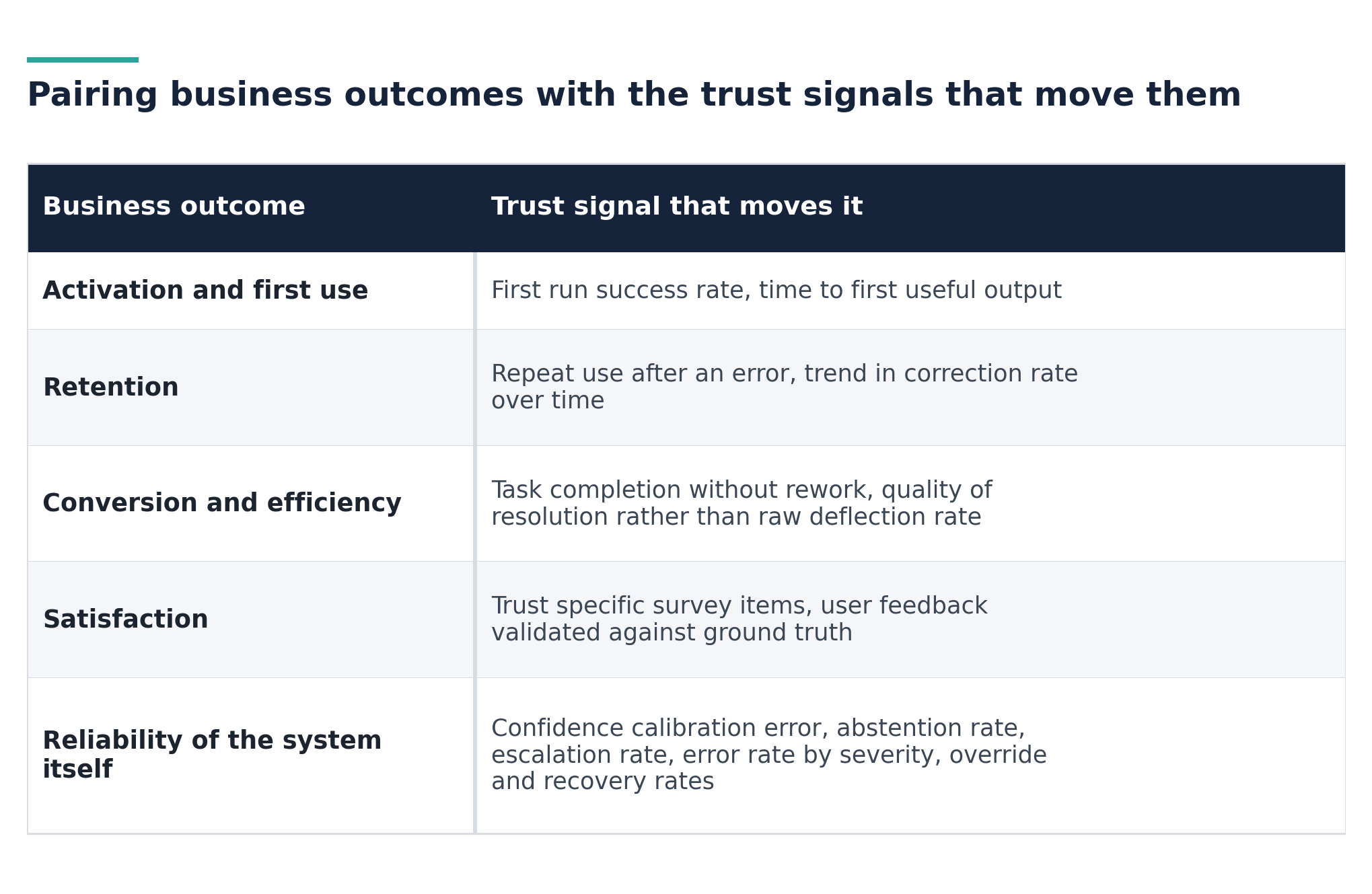
A few of these deserve emphasis because they are so easy to get wrong. The most important technical idea in measurement is to track the shape of failure, not just the average. A feature that is 92% accurate but fails catastrophically in its rare misses is less trustworthy than one that is 90% accurate but whose errors are minor and easy to recover from. Average accuracy hides the very thing that determines trust, which is what happens when the system is wrong. Tracking the distribution of error severity, rather than a single accuracy headline, is what tells you whether a feature is safe to expand.
Calibration deserves the same scrutiny. A confidence score is only useful if it reflects reality, so measure calibration error directly and treat a well-calibrated, honest system as a goal in its own right rather than a byproduct. Validate the feedback you collect as well. A thumbs-up from a user who did not notice the answer was wrong is not evidence of quality, so sample real outputs against the ground truth instead of trusting raw satisfaction signals at face value.
None of this is a one-time launch exercise. It depends on an evaluation suite that runs continuously, structured red teaming that actively hunts for failure modes before users find them, and production monitoring that watches for the data drift and concept drift that quietly degrade models over time. This is the operational discipline the broader field calls observability, and it is the difference between knowing what your AI is supposed to do and knowing what it is actually doing. Those two things are not the same, and only the second one earns trust.
Finally, all of this has to feed a loop. Corrections, complaints, escalations and failed evaluations should flow into a backlog that improves the system, so that trust compounds over releases rather than plateauing at launch. The products that win are not the ones that launched most trustworthy on day one. They are the ones whose trust curve kept climbing because every failure was converted into an improvement.
Align Teams Around a Shared, Lightweight Operating Model
Trust is irreducibly cross-functional, which is exactly why it falls through the cracks. Building a trustworthy AI feature touches product, design, engineering, data science, legal and privacy, security, and operations. When trust responsibility belongs to everyone in general, it belongs to no one in particular, and the seams between teams are precisely where trust failures breed.
The remedy is to make ownership explicit without inventing a bureaucracy. The product owns the outcome and, therefore, the trust requirements that protect it. Design owns expectation setting and the control surfaces that let users steer and correct. Engineering and data science own the evaluations, guardrails, and monitoring infrastructure. Legal and privacy own the mapping to regulation and the rules for handling data. Security owns resilience against adversarial manipulation. Operations owns incident response and the escalation paths. The titles matter less than the principle, which is that for every dimension of trust, a specific function can answer for it by name.
The governance that ties these roles together has to be lightweight, and lightweight carries a precise meaning here. It describes governance that helps teams move faster, not a committee that reviews everything and becomes a bottleneck. PwC’s 2025 Responsible AI research found that roughly half of executives name the translation of principles into operational processes as their single biggest hurdle, and only about half have even completed a basic inventory of their AI use cases. The organizations that clear that hurdle do so by embedding governance into the work, automating it where possible, and right-sizing it to risk. Templates appear at project initiation. Automated gates verify that the required documentation and evaluations are in place before a build can proceed. Dashboards surface issues without demanding a meeting. Compliance becomes the path of least resistance rather than a detour around it.
The most direct way to embed trust into a product roadmap is to give every AI feature a trust definition of done. Just as a feature is not finished until it meets its functional acceptance criteria, an AI feature should not be considered shippable until it meets its trust acceptance criteria, decided at the same moment as the functional requirements rather than negotiated after the fact. Those criteria scale to the feature’s risk tier, as shown below.
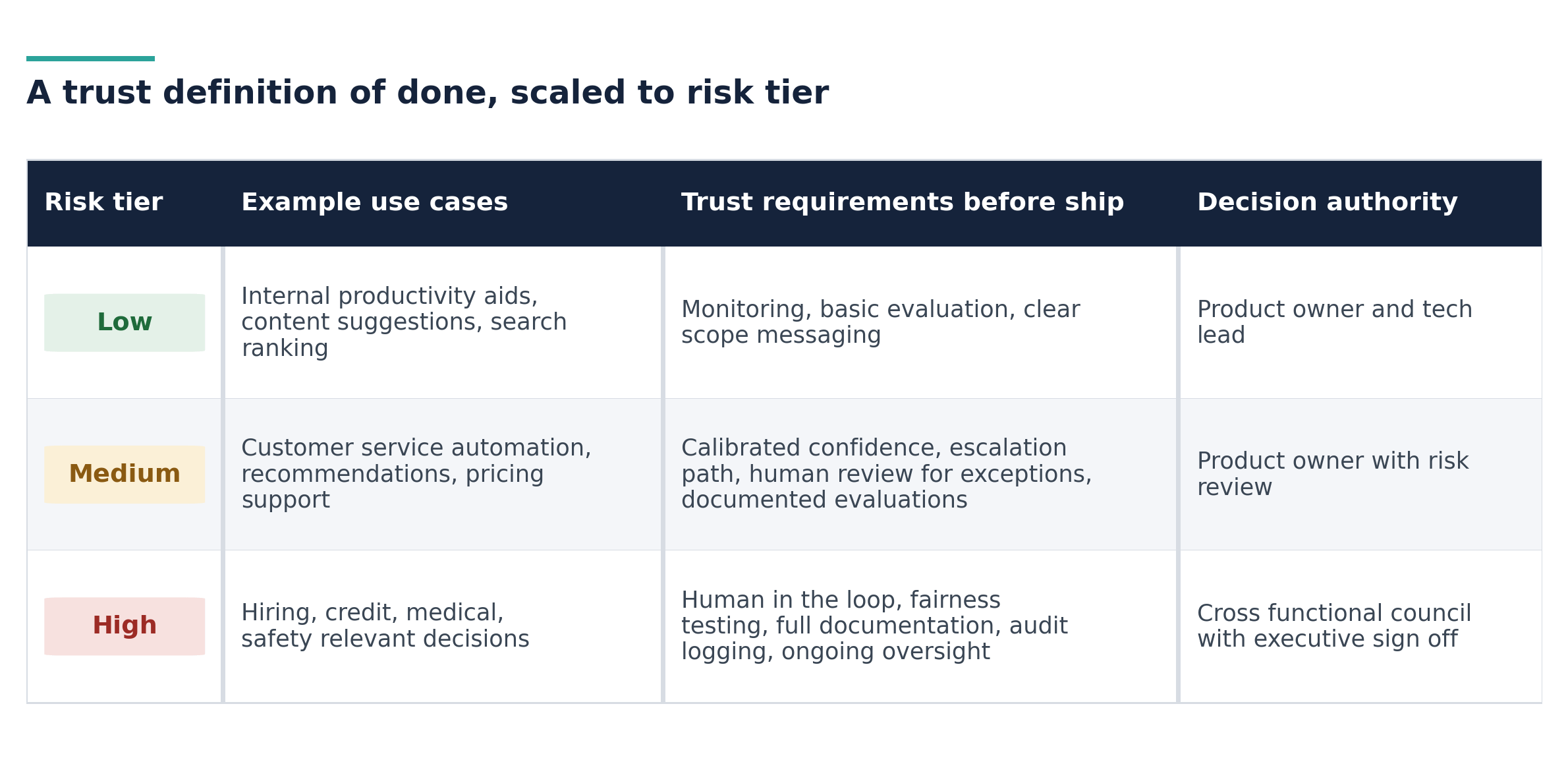
This single mechanism does much of the work that a Trusted AI strategy is supposed to do. It connects trust to the roadmap, scales effort to risk, and gives product teams a clear, predictable standard rather than a moving target to guess at. Shared standards finish the picture. A common feature documentation format, often called a model card, an agreed evaluation rubric, and a documented review and decision process, all let teams move quickly precisely because they are not re-litigating the fundamentals on every project. Standards are not bureaucracy. They are the reason a team does not have to reinvent trust from zero each time it starts something new.
Roll Out in Phases
Ambition is not a rollout strategy. The organizations that scale Trusted AI do so by deliberately sequencing, matching the order of deployment to risk and value rather than to enthusiasm or to whoever lobbied hardest.
Begin with low-risk, high-value use cases. Internal productivity tools, assistive features that keep a human in the loop, and reversible actions are ideal first steps because they enable a team to capture real value and learn the operating model in an environment where the downside of a mistake is contained. The point of starting small is not timidity. It is to build the organizational muscle to detect and recover from failure before the stakes are high enough to punish a beginner’s mistakes.
Use pilots to find where trust breaks down, not only to prove it works. A good pilot is heavily instrumented and judged against exit criteria defined before launch, including both product metrics and trust signals that must hold for the feature to graduate. The most valuable output of a pilot is often the catalog of failure modes, confusing interactions, and unexpected support load it surfaces, because those are precisely the things that would have quietly killed the feature at scale. A pilot that only confirms the happy path has not done its real job.
Expansion should be gated by readiness, not by the calendar. A feature earns the right to move to a higher-stakes use case once its experience, metrics, and controls have proven stable at the current tier, and the team has demonstrated it can catch and recover from failures. Promotion gates of this kind keep an organization from sleepwalking into a high-risk deployment it is not actually prepared to run.
Timing is not abstract here. The European Union’s AI Act brings its obligations for high-risk AI systems into force on the second of August, 2026, placing concrete legal requirements around exactly the kind of consequential applications, such as hiring and credit decisions, that sit at the top of the risk ladder, with penalties that can reach tens of millions of euros or a meaningful percentage of global turnover. Phasing protects an organization from shipping into a regulated tier without the documentation, human oversight, and risk management that those rules require. A disciplined rollout is not only good product practice. It is increasingly the difference between a compliant deployment and an expensive after-the-fact remediation.
The Strategic Payoff
Return to the gap that opened this piece. Adoption of AI is nearly universal, and realized value remains rare. The distance between the two is the trust and reliability gap, and closing it is where the durable returns live. A Trusted AI strategy is, at bottom, the discipline of converting experimentation into dependable adoption, which is another way of saying it converts capability into value.
This is why the strongest AI strategies are not merely the most powerful ones. They are also understandable, usable, and dependable. Capability gets an organization a demo and a headline. Trust is what gets a business. The work described here, defining trust in product terms, designing for the experience, building guardrails into the workflow, measuring trust as rigorously as any other outcome, aligning teams around a light operating model, and rolling out in phases, is the work of turning an impressive capability into something people will actually rely on day after day.
It also resolves the adoption problem that defeats most governance-led efforts. Product teams adopt what helps them ship better outcomes with less friction. When a Trusted AI strategy is framed and built so that trust moves the metrics by which those teams are measured and removes the blockers that slow them down, adoption stops being a mandate to enforce and becomes a choice teams make because it serves their own goals. That is the only kind of adoption that lasts. And the value on the other side is real for those who get there. PwC’s 2025 Responsible AI research found that nearly sixty percent of executives say responsible AI practices boost return on investment and efficiency, and a majority report gains in customer experience and innovation. Trust, done well, is not a cost center. It is a growth lever.
The question facing every organization is not whether its AI features will need to be trustworthy. The market, the regulators, and the users have already settled that. The question is whether trust will be deliberately designed into the strategy, on terms that product teams embrace because it helps them win, or retrofitted reactively after the adoption curve has flattened. Failures have taught users to look elsewhere. The first path produces AI that scales. The second produces a portfolio of impressive features nobody relies on. The time to choose the first path is now.